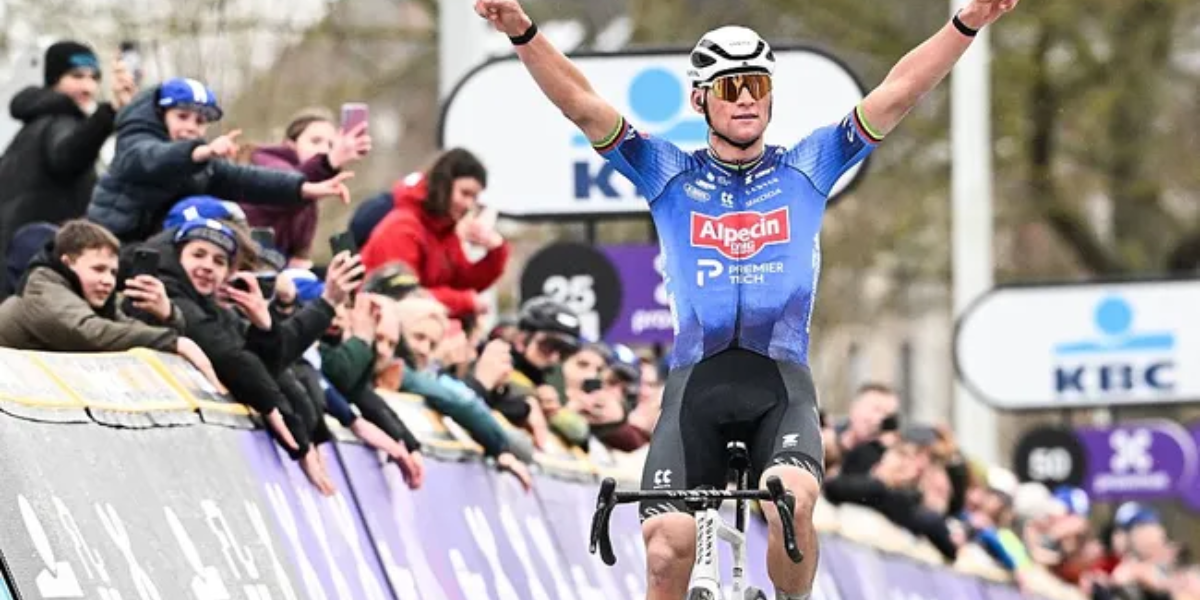
Geraardsbergen (The Brussels Morning Newspaper) – October 10, 2026 – Mathieu van der Poel won the 2026 Omloop Het Nieuwsblad after attacking on the Muur van Geraardsbergen and riding alone to the finish in Ninove. The Dutch rider secured victory on his first appearance in the Belgian one-day Classic, which opened the Flemish spring racing season. Tim van Dijke finished second, while Florian Vermeersch took third place after the decisive selection developed in the closing stages. The 207.6-kilometre race was marked by wet conditions, crashes and a series of attacks across the demanding Flemish roads.
- How Did Van der Poel Secure Victory at Omloop Het Nieuwsblad?
- Why Was the Muur van Geraardsbergen Decisive?
- Who Finished Second and Third in the Belgian Classic?
- How Did Wet Weather and Crashes Affect the Race?
- What Happened During the Earlier Stages of the Race?
- What Did Van der Poel Say About His Race Strategy?
- What Made the Victory Significant for Van der Poel?
- What Is the Background of Omloop Het Nieuwsblad?
The victory gave Van der Poel an immediate result in his first road race of the 2026 season and added Omloop Het Nieuwsblad to his list of major one-day race achievements. The Alpecin-Premier Tech rider entered the event after a successful cyclo-cross campaign and made his presence decisive during the final sequence of climbs. His acceleration on the Muur separated him from the riders who had accompanied him towards the front of the race, leaving him to complete the remaining distance without a successful challenge from behind.
How Did Van der Poel Secure Victory at Omloop Het Nieuwsblad?
Van der Poel’s winning move developed from the sequence of attacks that reshaped the leading group during the second half of the race. Rather than waiting for a sprint from a larger group, he used the climbs and the changing race situation to establish a decisive advantage over his principal rivals.
The 81st edition of Omloop Het Nieuwsblad covered approximately 207 kilometres between Ghent and Ninove in Belgium. The event formed the opening race of the Flemish spring Classics, a period of the professional cycling calendar characterised by narrow roads, cobbled sectors, short climbs and repeated changes in pace.
Van der Poel had not previously participated in Omloop Het Nieuwsblad. His decision to join the start list therefore attracted attention, particularly because the race came shortly after his cyclo-cross season. He had added the event to his programme only days before the race after assessing his condition.
Once the race entered its decisive phase, Van der Poel demonstrated the ability to respond to attacks and move into the leading group. His race developed around the Molenberg, where he joined Florian Vermeersch of UAE Team Emirates-XRG and helped establish a move that eventually included Tim van Dijke of Red Bull-Bora-Hansgrohe and other riders.
The leading group built an advantage over the pursuing peloton, although its composition changed as the race progressed. Van der Poel remained positioned to attack when the riders reached the Muur van Geraardsbergen, one of the defining climbs of the event.
He accelerated on the climb and opened a gap over his companions. The move proved decisive, with Van der Poel continuing alone towards Ninove and maintaining his advantage until the finish.
The Dutch rider crossed the line ahead of Van Dijke and Vermeersch. The official race history records the three riders as the first, second and third finishers respectively.
Why Was the Muur van Geraardsbergen Decisive?
The Muur van Geraardsbergen played a central role in determining the outcome because it provided Van der Poel with the opportunity to turn his position in the leading group into a solo breakaway.
The climb is among the best-known features of Belgian one-day racing. Its steep gradients and cobbled surface place sustained demands on riders, while its position within the route makes it an important point for attacks before the finish in Ninove.
According to Cyclingnews’ race report, Van der Poel made his decisive move with approximately 16 kilometres remaining. He separated himself from Vermeersch and Van Dijke and began the final part of the race alone.
Van der Poel had indicated that the Muur was the point at which he intended to attack. However, the developments earlier in the race influenced how he reached that stage. His move towards the front after the Molenberg placed him in a position to contest the finish from a smaller group rather than relying on the main peloton.
The attack left his rivals with limited time to organise a response. Van der Poel continued through the remaining kilometres, negotiating the course before reaching the finish in Ninove.
The Bosberg, another prominent climb on the route, followed the Muur in the final sequence. Van der Poel maintained his solo effort across this section and did not surrender his lead before the finish.
The gap between the winner and his closest pursuers confirmed the effectiveness of the move. Van Dijke and Vermeersch continued their contest for the remaining podium positions, but neither could close the distance to Van der Poel.
The outcome also demonstrated the importance of positioning before the final climbs. Van der Poel had already reached the front group through the earlier racing, allowing him to attack from a position where he did not first have to bridge a substantial gap to the leaders.
Who Finished Second and Third in the Belgian Classic?
Tim van Dijke secured second place, while Florian Vermeersch completed the podium in third. Both riders had been part of the race’s decisive front group before Van der Poel’s attack on the Muur.
Van Dijke represented Red Bull-Bora-Hansgrohe, while Vermeersch rode for UAE Team Emirates-XRG. Their positions reflected the importance of the earlier selection, which brought a small number of riders ahead of the main field during the closing stages.
After Van der Poel moved clear, the two riders were left to contest the remaining podium places. Van Dijke won the sprint for second, finishing ahead of Vermeersch.
Cyclingnews reported that Van Dijke benefited from the tactical situation in the group behind the winner. With the race already decided at the front, the battle for second place became a separate contest in which the riders had to manage their efforts and respond to one another.
The final standings placed Van der Poel first, Van Dijke second and Vermeersch third. The official Omloop Het Nieuwsblad race history confirms those positions in its record of the 2026 men’s elite event.
The podium also represented an important result for the teams involved in the spring Classics. Red Bull-Bora-Hansgrohe placed Van Dijke among the leading finishers, while UAE Team Emirates-XRG secured third place through Vermeersch.
Although the contest for victory ended with Van der Poel’s solo attack, the competition behind him continued until the finish. The sprint for second demonstrated that the remaining riders were still competing for the best possible result after the leading position had become increasingly difficult to challenge.
How Did Wet Weather and Crashes Affect the Race?
The 2026 edition was marked by wet conditions and several crashes, adding further difficulty to a route already shaped by cobbled roads and repeated climbs.
Omloop Het Nieuwsblad is traditionally a demanding early-season race. Riders must manage their positioning in large groups while navigating narrow roads and technical sections. When the surface is wet, maintaining control becomes particularly important, especially when the peloton approaches climbs or changes direction at speed.
Cyclingnews reported that crashes affected several competitors during the event. Among the riders affected were Matthew Brennan, Tom Pidcock and Tim Wellens, whose incidents disrupted their opportunities to compete at the front.
One of the significant moments involved Matteo Trentin falling on the Molenberg. Van der Poel avoided going down and was able to continue through the section, helping establish the move that became the foundation of his winning effort.
Cyclingnews’ race coverage highlighted Van der Poel’s bike handling during the incident. Remaining upright allowed him to preserve his position as the race developed, while the disruption created opportunities for riders who were able to continue without losing ground.
The conditions also required teams to manage their riders carefully throughout the race. Crashes can split the field, interrupt organised pursuit efforts and force competitors to expend energy returning to the main group.
The effect of such incidents varies according to their timing and the riders involved. In this race, the crashes formed part of the wider sequence of events that shaped the leading group, although the final result was determined by the attacks and responses on the later climbs.
The race continued towards Ninove, where Van der Poel’s advantage proved sufficient to secure victory. The incidents remained a significant feature of the day’s racing, but the official results established the final order among the leading finishers.
What Happened During the Earlier Stages of the Race?
The race began in Ghent and covered approximately 207.6 kilometres before finishing in Ninove. Its route included 12 climbs, with the Molenberg, Muur van Geraardsbergen and Bosberg among the important features of the closing stages.
An early breakaway formed as riders sought to establish a lead over the main field. The initial group contained five riders, according to Cyclingnews’ coverage. Their advantage was eventually eliminated as the peloton increased its pace and teams began preparing for the decisive part of the course.
The breakaway was caught with approximately 42 kilometres remaining, bringing the main field back together before the final selection developed. The pace and repeated changes in position subsequently reduced the number of riders able to contest the victory.
Van der Poel became involved in the decisive action after the Molenberg, approximately 45 kilometres from the finish. He bridged across to Vermeersch, who had moved ahead, and the developing group subsequently included Van Dijke and other competitors.
The move created a different race dynamic. Instead of approaching the final climbs as part of a large peloton, Van der Poel was able to contest them from a smaller group of riders already at the front.
The sequence was important because the Muur came late enough in the race to provide a final opportunity to separate the strongest riders. Once Van der Poel accelerated there, the remaining competitors had to decide whether to pursue him individually or concentrate on their own positions.
His attack ultimately settled the contest for first place. The earlier breakaway, the selection on the Molenberg and the final acceleration on the Muur were all part of the sequence leading to his victory.
What Did Van der Poel Say About His Race Strategy?
Van der Poel explained after the race that his original plan had been to wait until the Muur van Geraardsbergen before making his decisive attack. The developments around the Molenberg, however, altered the way he reached the final selection.
Cyclingnews reported that Van der Poel identified Vermeersch’s move as an important moment. Because he knew the Belgian from previous off-road racing, he recognised the opportunity to bridge across and join the attack.
Van der Poel said the move would not have been possible without Vermeersch. He also explained that the Molenberg had become a crucial point in the race, even though he had not initially planned to attack there.
His comments indicated that the race required him to adapt his strategy as the situation changed. After joining the front group, he was able to return to his intended plan of attacking on the Muur.
Van der Poel also discussed the cooperation required within the breakaway. He noted that Vermeersch had a reason to contribute to the move because it offered him an opportunity to secure a podium finish.
The result reflected the interaction between individual strength and tactical decisions. Van der Poel made the winning attack, but his position at the front had developed through the earlier moves and the cooperation between riders.
What Made the Victory Significant for Van der Poel?
The victory was significant because Omloop Het Nieuwsblad was a new event on Van der Poel’s road-racing programme. The Dutch rider won on his first appearance, adding the Belgian Classic to a career already distinguished by success across several cycling disciplines.
Before the race, Van der Poel had been competing in cyclo-cross. He had also secured his eighth world cyclo-cross title earlier in February 2026, according to contemporary race coverage.
His decision to enter Omloop came shortly before the event. The race therefore marked his return to road competition for the new season, rather than the continuation of a road campaign already under way.
Cyclingnews reported that his first-participation victory placed him among a small group of riders to have won the race on their debut. The publication noted that the previous rider to achieve this feat was Michele Bartoli in 2001.
The result also added another major Flemish race to Van der Poel’s record. The region’s spring Classics include events that place particular emphasis on cobbled sectors, short climbs and tactical positioning, all of which featured prominently in the race in Ninove.
His performance was achieved despite the difficult conditions and the crashes that affected the field. The decisive attack on the Muur separated him from the other leading riders, while his solo ride ensured that the result did not depend on a sprint finish.
The victory established Van der Poel as the winner of the 2026 edition and gave Alpecin-Premier Tech the top position in the opening race of the Flemish spring Classics.
What Is the Background of Omloop Het Nieuwsblad?
Omloop Het Nieuwsblad is a Belgian one-day road race traditionally associated with the opening of the Flemish spring Classics season. Its route between Ghent and Ninove takes riders across roads and climbs that have become familiar features of professional racing in Flanders.
The event is part of the UCI WorldTour calendar and attracts leading riders and teams preparing for the spring’s major one-day races. Its position early in the season makes it an important competitive test following the winter training period and, for some riders, the cyclo-cross campaign.
The race’s identity is closely connected to its cobbled sections and short, demanding climbs. These features reward riders who can maintain their position in a group, respond to repeated accelerations and make tactical decisions under pressure.
The Muur van Geraardsbergen is among the most recognisable climbs associated with the event. Its combination of gradient and cobbles makes it a prominent location for attacks, particularly when the leading riders approach it with limited distance remaining.
The official race history records Van der Poel as the 2026 men’s elite winner, followed by Van Dijke and Vermeersch. The same record identifies the victory as Van der Poel’s first participation in the event.