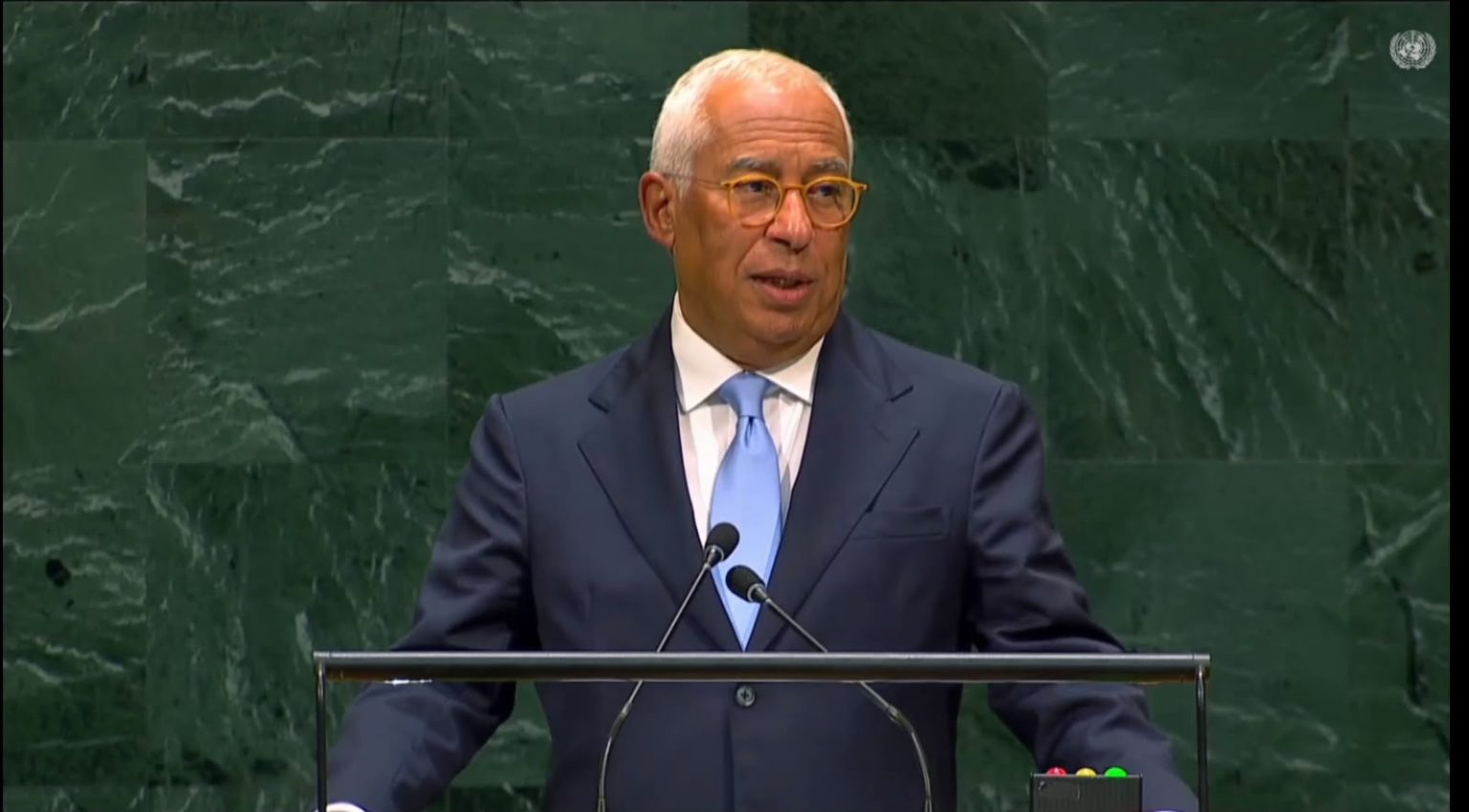
European Council President António Costa used his address to the 81st United Nations General Assembly to make a strong case for renewed multilateralism, arguing that the world’s most pressing challenges cannot be addressed effectively by countries acting alone.
“Multilateralism is not an ideal of the past. It is the only realistic way to address the problems of today,” Costa said. He pointed to armed conflicts, climate change, artificial intelligence, economic insecurity, pandemics and fragile global supply chains as challenges that require stronger international cooperation and coordinated responses.
A central theme of Costa’s speech was the need to ensure that artificial intelligence remains accountable and governed in the public interest. He called for a transparent international regulatory architecture and warned that decisions over AI governance cannot be left to a small number of major global technology companies. Costa said the United Nations should play a central role in developing international cooperation on AI through initiatives including the Global Digital Compact, the Independent International Scientific Panel and the Global Dialogue on AI Governance.
Costa also defended the United Nations as the centre of the multilateral system despite growing geopolitical divisions, financial pressures and institutional weaknesses. He backed reform of the UN Security Council to make it more effective, inclusive, democratic and accountable, while also expressing support for the UN80 reform initiative.
The European Council president announced the launch of P4M — Partners for Multilateralism, International Law, Peace and Prosperity — an initiative involving the European Union, Australia, Barbados, Brazil, Canada, India and Kenya. Costa described the initiative as an open platform intended to build coalitions, strengthen international cooperation and support reform of the multilateral system.
International law was another major focus of the address. Costa stressed that there can be “no double standards” and reaffirmed European support for the International Court of Justice and the International Criminal Court. He argued that accountability must not depend on political convenience and condemned threats directed against the ICC and its personnel.
Turning to major international conflicts, Costa called for an end to Russia’s war against Ukraine and urged the international community to use all available means to create conditions for what he described as a “comprehensive, fair and lasting peace”. On the Middle East, he reiterated the European Union’s support for a two-state solution, with Israel and an independent and democratic Palestine living side by side in peace and security. Costa also called for the preservation of freedom of navigation through the Strait of Hormuz and said Iran must never be allowed to acquire a nuclear weapon.
Costa paid tribute to UN Secretary-General António Guterres, describing his work on international law, human rights, climate action, sustainable development and reform of global financial institutions as a “beacon” for international cooperation.
The speech also highlighted the European Union’s expanding international partnerships and trade agreements while stressing that cooperation between countries must extend beyond trade. Costa warned that progress towards the UN’s 2030 Sustainable Development Agenda is at risk because of widening financing gaps, the worsening climate crisis and geopolitical divisions.
Summarising the European Union’s approach to international cooperation, Costa presented four contrasting principles: “Cooperation over confrontation. Law over power. Partnership over isolation. Action over paralysis.”
Costa concluded his address by calling on governments to renew their commitment to collective international action and reform of the multilateral system. “Let us reform. Let us renew. Let us reinvest. And let us act. Together.”