New York (Brussels Morning Newspaper) September 23, 2026 – Iranian President Masoud Pezeshkian declared at the United Nations General Assembly that Tehran would never surrender to the United States. His address followed threats of annihilation from US President Donald Trump, prompting a walkout by the US delegation. While the Iranian leader maintained a defiant stance against economic and military pressure, he noted that Iran still believes in diplomacy to resolve ongoing conflicts.
Addressing the annual gathering of world leaders in New York on Wednesday, Iranian President Masoud Pezeshkian stated that Tehran would not capitulate in the ongoing conflict with the United States. The remarks came directly in response to comments made a day prior by US President Donald Trump, who stated he was weighing whether to “annihilate” Iran, while concurrently acknowledging renewed indirect talks between negotiators from Washington and Tehran.
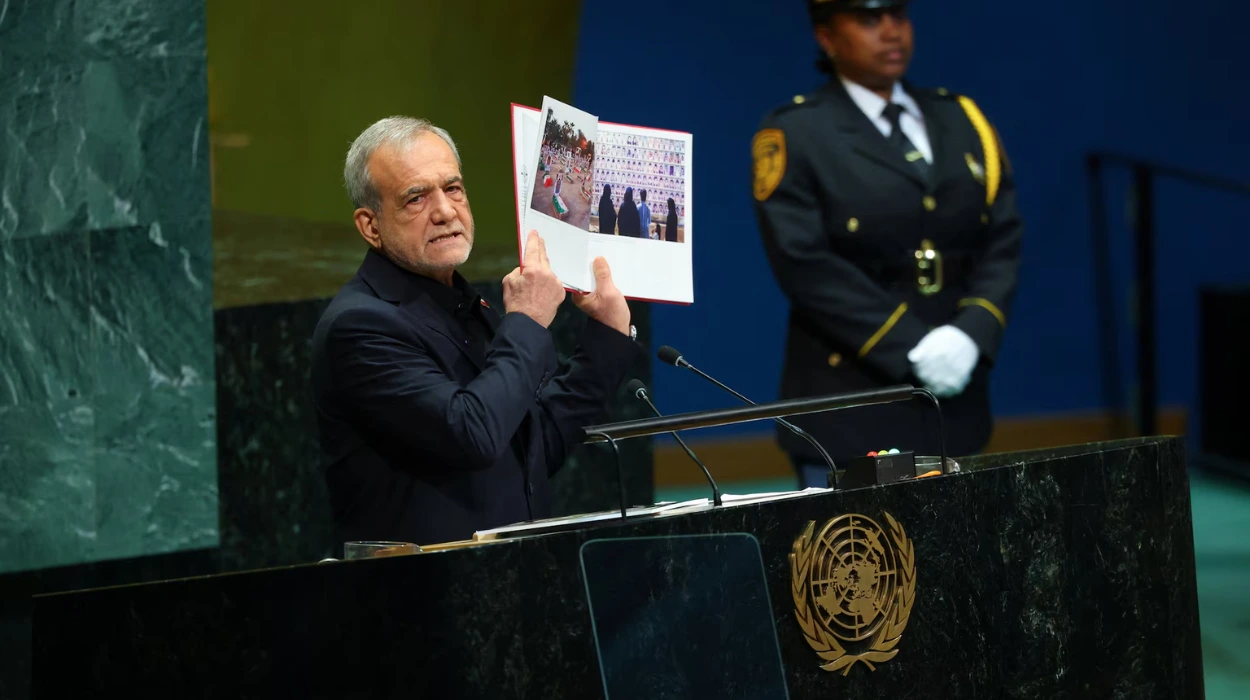
As President Pezeshkian took the podium, members of the United States delegation walked out of the General Assembly hall. The US mission to the United Nations did not immediately respond to requests for comment regarding the walkout. Pezeshkian made no direct reference in his speech to the recent indirect talks aimed at addressing the stalled war.
Standing before the international body, Pezeshkian warned that the Iranian population would only grow more resilient under the weight of increased sanctions, political pressure, and external bullying. He emphasized that Tehran would never bow its head or bend at the knee.
Developments Surrounding the Strait of Hormuz
A central focus of Pezeshkian’s address was the Strait of Hormuz, a critical maritime passage that previously handled a fifth of global oil and liquefied natural gas before the outbreak of hostilities. The waterway has experienced intermittent blockades and heightened tensions since the conflict began, causing global energy prices to surge.
Pezeshkian criticized the current dynamics governing the trade route, arguing that external powers could not expect unrestricted access while simultaneously using the region for military hostility.
“It cannot be the case that everyone benefits from the Strait of Hormuz while we are denied access to shipping through this waterway,”
Pezeshkian said.
“The permanent deployment of hostile fleets and the expansion of the war will not lead to peace.”
He added that Tehran would not permit the waterway to be utilized as a staging ground for aggression against Iranian sovereignty. Rising fuel prices resulting from disruptions in the region have added domestic political pressures in Western nations, including the United States, ahead of upcoming legislative midterms.
Regional Security and Historical Grievances
President Pezeshkian asserted that regional issues must be resolved exclusively within the Middle East by local governments, free from interference by external actors. Directing his comments toward nations he deemed responsible for military actions against his country, Pezeshkian stated that these states had tested Iran and found that the nation cannot be forced to surrender.
Maintaining that Iran has historically acted defensively rather than aggressively, Pezeshkian noted that the country has consistently demonstrated a commitment to the negotiating table despite having conflicts imposed upon it. He vowed that the country would defend its homeland until the final breath.
During his address, Pezeshkian raised photographs documenting casualties from earlier military strikes, referencing the death of Supreme Leader Ayatollah Ali Khamenei during a joint US-Israeli strike in Tehran on February 28, alongside victims from the bombing of a girls’ school in the southern Iranian city of Mina on the same day. A preliminary US intelligence review in March indicated that American forces were likely connected to the February 28 operation, though it concluded the school was not intentionally selected as a target. Conversely, an independent UN fact-finding report released earlier in the month stated that the United States failed to adequately verify information prior to the strike, concluding there are reasonable grounds to classify the event as a war crime.
Diplomatic Logistics and Visa Restrictions
The logistics surrounding President Pezeshkian’s travel to the United States were subject to prolonged uncertainty. His attendance at the high-level diplomatic summit in Manhattan remained in question for weeks due to delays in determining whether Washington would issue a travel visa.
While authorization was ultimately granted for the Iranian president, US authorities denied entry visas to several members designated for Pezeshkian’s official entourage.
Despite the tense diplomatic exchanges, harsh rhetoric, and the visible absence of the US delegation during his speech, Pezeshkian maintained that diplomacy remains a viable avenue for concluding the conflict. Financial markets have closely monitored the rhetoric, with international oil prices registering modest gains amid ongoing concerns over supply stability and geopolitical friction in the Middle East.