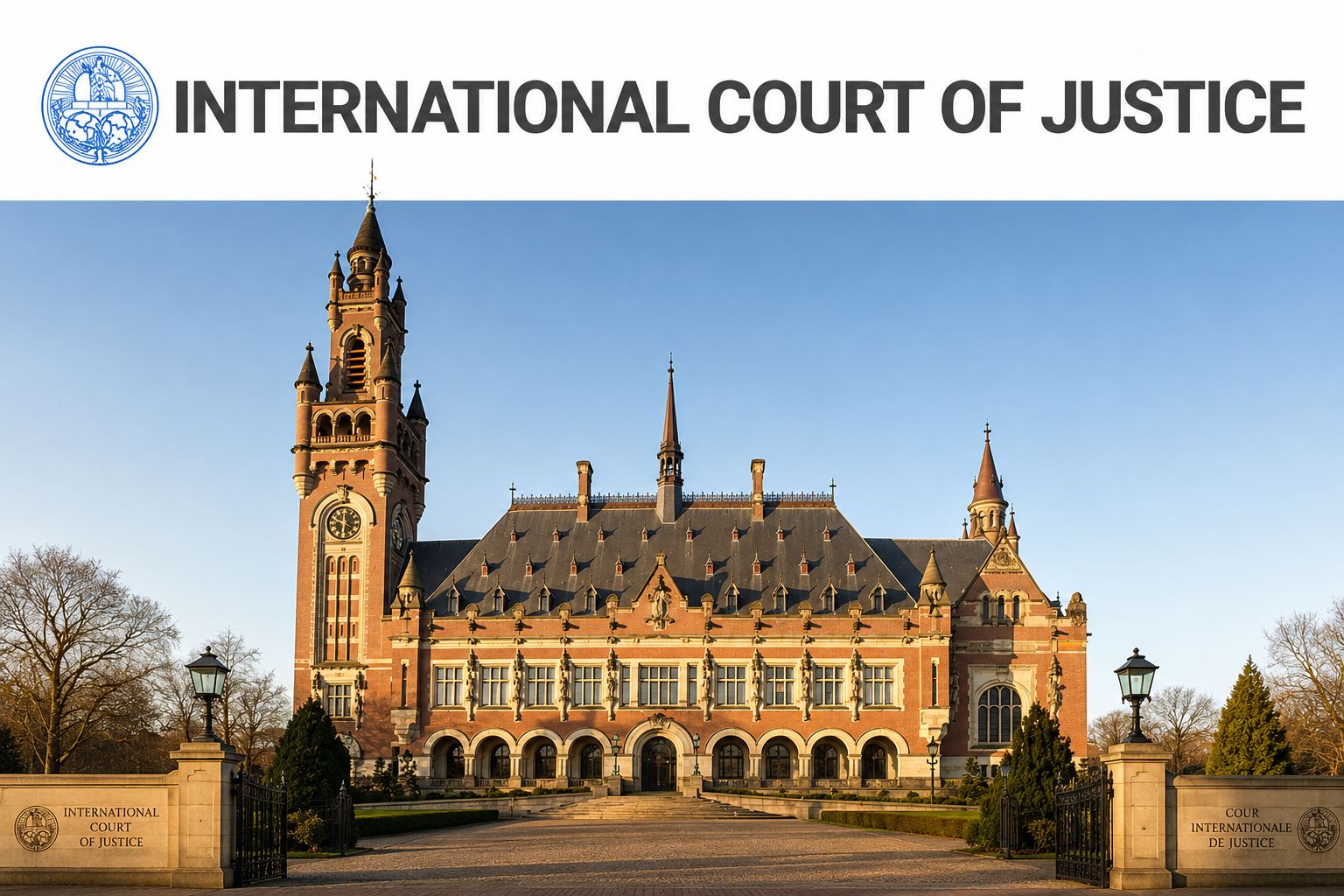
The Democratic Republic of Congo filed proceedings against Rwanda at the International Court of Justice in the week of its 66th independence anniversary, in what victims’ groups and government officials are describing as the most significant international accountability action the country has ever taken — while simultaneously pressing Belgium to return more than 500 human remains held in European institutions since the colonial era.
The double move has put Congo’s pursuit of justice squarely on the European agenda. Prime Minister Judith Suminwa Tuluka, who became the DRC’s first female head of government in June 2024, personally wrote to her Belgian counterpart earlier this month requesting the restitution of Congolese skulls and other remains held in Belgian institutions since the nineteenth century. The request forms part of an ongoing memorial process between Kinshasa and Brussels that has gathered pace under the Suminwa government, and it lands in a Belgian political environment already navigating difficult questions about its colonial legacy in central Africa.
The ICJ application, lodged on 26 June 2026, accuses Rwanda of bearing international responsibility for more than thirty years of atrocities in eastern DRC — massacres, extrajudicial executions, sexual violence, torture, forced displacement, and discrimination on grounds of ethnicity and sex. It invokes four international conventions, including the Convention on the Prevention and Punishment of the Crime of Genocide and the Convention against Torture. Approximately 1,478,177 victims have been identified to date by FONAREV, the national reparations body established by Congolese law in December 2022.
Patrick Fata Makunga, Director General of FONAREV, said: “The referral to the International Court of Justice constitutes a major step in the quest for truth, justice and reparation for the victims of grave crimes committed in the Democratic Republic of Congo. For FONAREV, this step reaffirms that lasting peace cannot be built without recognition of suffering, responsibility and full reparation for victims.”
François Kakese Kimaza, Executive Coordinator of CIA-VAR, the inter-institutional body overseeing victim support and reform, added: “The referral to the International Court of Justice reflects the determination of the Democratic Republic of Congo to bring before the competent authorities the voice of victims and the demand for truth. For CIA-VAR, this step is part of an essential struggle for the recognition, accountability and reparation of grave crimes committed on our territory, in direct alignment with the national strategy of which CIA-VAR ensures the technical implementation.”
Rwanda has not publicly responded to the proceedings.
A Government Asserting Itself on the World Stage
The ICJ filing and the restitution request to Belgium are the two most visible expressions of a broader posture that has defined the Suminwa government’s approach to international affairs. In June 2025, the DRC was elected to the UN Security Council for the 2026–2027 term, securing 183 votes out of 187 — its first seat since 1990–1991, and a signal that Kinshasa is actively reclaiming its place in international deliberation rather than being merely a subject of it. In January 2026, the government formally recognised Kuba motifs and textiles as national cultural heritage, affirming the state’s obligation to protect and transmit Congolese civilisation.
Social and Economic Gains, With Caveats
The international assertiveness sits alongside a domestic reform agenda that has produced measurable results, though not without difficulty. Free primary education, pursued continuously since 2019, has driven school enrolments from approximately 12 million to more than 20 million pupils. More than two million births have been covered free of charge under the universal health coverage programme since September 2023, with more than 50,000 vulnerable newborns receiving care across more than 4,600 health facilities nationwide. Military and police salaries were doubled from March 2025, with a front-line combat bonus introduced alongside.
The government’s Local Development Programme is targeting 2,130 infrastructure projects across the country’s 145 territories, with completion rates currently between 76% and 83%. The state budget grew from 32,456.8 billion Congolese francs in 2023 to 54,335.8 billion francs in the 2026 Finance Act — a rise of nearly 67% in three years — though revenue pressures forced a downward revision earlier this year.
The conflict in the east continues. The gap between announcement and implementation has at times been significant. Suminwa has governed through a fragile currency, an active war, and repeated public health emergencies, and has done so as the first woman in the role — facing a ferocity of personal attack that prompted hundreds of Congolese women to take to the streets in protest.
What It Means for Brussels
The restitution request carries particular weight in the Belgian context. Belgium’s relationship with its former colony in central Africa remains one of the most contested aspects of its historical legacy, with the question of colonial-era human remains held in Belgian scientific and cultural institutions having been under discussion for several years. Suminwa’s decision to pursue the request through a direct prime ministerial letter signals that Kinshasa intends to press the matter at the highest political level.
For survivors in eastern DRC — whose suffering has been documented in UN reports and international inquiries for decades with little to show in terms of accountability — the ICJ filing means something more immediate. Their suffering now has a docket number at the world’s highest court.
“The silence has lasted too long,” said Kimaza. “Today, a new chapter opens.”