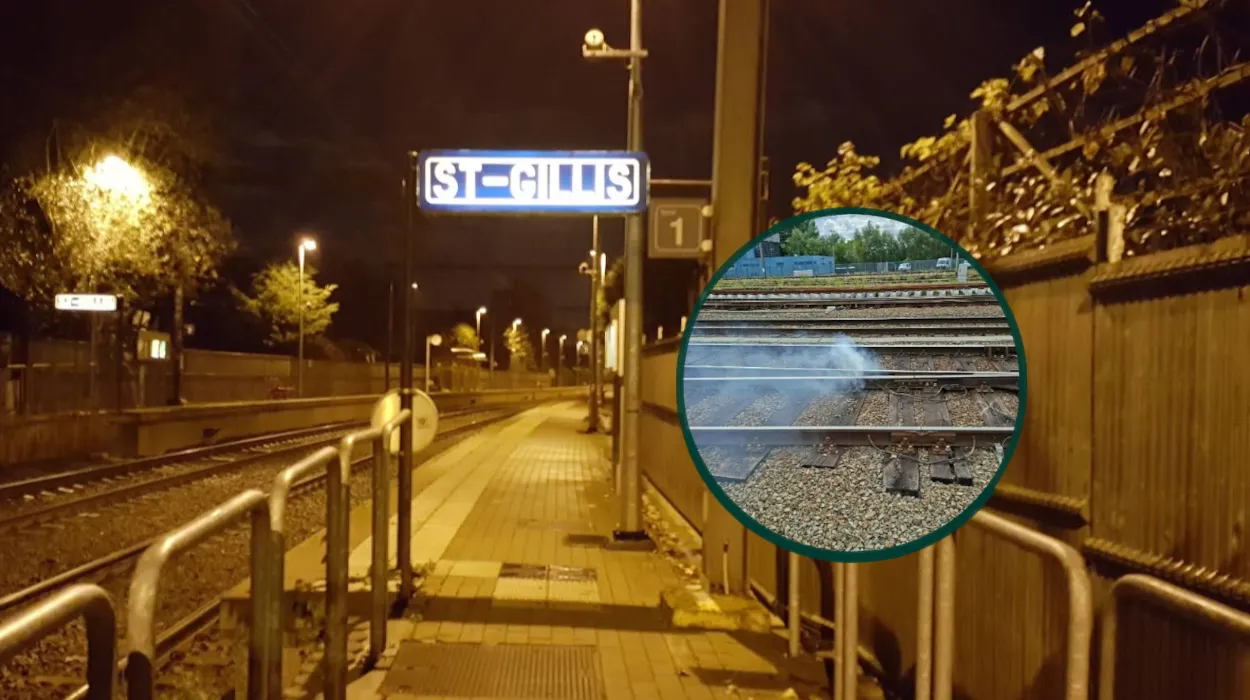
Dendermonde (Brussels Morning Newspaper) – Train traffic was temporarily halted on Wednesday afternoon after a small fire broke out on the railway tracks at Boonwijkstraat in Sint-Gillis-Dendermonde, a locality within the Dendermonde municipality in East Flanders, Belgium.
While the event was initially described as a trackside fire in initial reports and not one in a train, it did lead to the appropriate safety protocol being implemented. This included stopping the trains, calling for emergency services, and inspecting the line prior to allowing the trains to continue. Initial bulletins showed there to be no injuries and that damage was likely to have been caused only in the trackside region.
The time of occurrence—Wednesday afternoon on 2 September 2026—put the disruption squarely during peak travel times, making it more likely to have repercussions in terms of delays and disruptions in other connecting services. Although no specifics regarding minutes of delays or canceled trains were reported, the method followed seemed consistent with the Belgian railways’ method: once a fire is detected in the vicinity of the tracks, all trains stop running until the fire is put out.
Why did trains stop immediately after the fire?
As a matter of fact, the fire in the railway corridor is considered a very serious situation due to its ability to affect signaling cables, sleepers, and ballast through heat, smoke, and flames. For this reason, Infrabel, which is the organization responsible for managing the Belgian infrastructure, has always made it clear that trains will not be allowed to depart unless the fire has been extinguished and the extent of the damages is evaluated.
NMBS (Belgian Railways), which provides passenger services, normally arranges the use of buses as an alternative, or rerouting, whenever Infrabel makes part of the line under their control out of service. The representatives of the company always argue that all services only restart once Infrabel declares the line ready to be used again, and it appears that their position corresponds to what happened in Dendermonde. It follows that a “minor” fire could lead to the stopping of all services in case it happens near the operating line.
What have officials said about safety and delays?
Public messaging from rail authorities in such cases tends to be concise and safety-first. Infrabel’s position, reiterated through multiple incidents this year, is that
“trains are stopped until the fire is out and the area is inspected for damage”,
a formulation that captures the non-negotiable nature of post-fire safety checks. NMBS echoes this by noting that
passenger services resume only after Infrabel certifies the line is safe,
ensuring that operational decisions are anchored in infrastructure clearance rather than timetable pressure.
Are there similar recent incidents on Belgian railways?
Dendermonde represents one such case out of the series of rail corridor fires and risks that have affected the Belgian rail network recently. The disruption of lines 1 and 5 of the Brussels metro on 2 September 2026 resulted from the burning of a wooden sleeper in a tunnel between the stations Étangs Noirs/Zwarte Vijvers, resulting in smoke and evacuating the passengers before putting out the fire. There was a disruption in train traffic between Bruges and Knokke in late August due to some problem in the infrastructure necessitating intervention by Infrabel, and there was again a disruption in train traffic between Bruges and the coast because of a gas leak close to the railway.