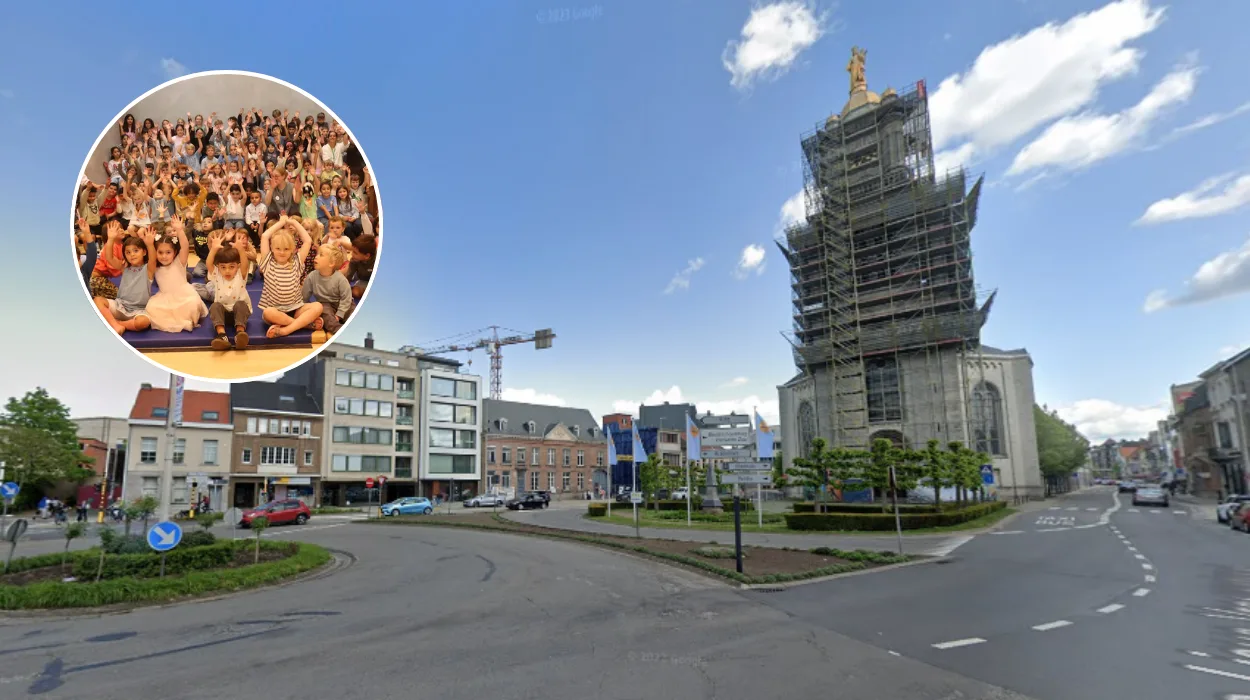
Sint-Niklaas (Brussels Morning Newspaper) – In Sint-Niklaas, the 2026-2027 academic year did not begin with an assembly or even the quiet introduction of the first morning. In the Freinetschool Arker Universalis, students came back to class on Tuesday, 1st September 2026, for a day filled with experiments, demonstrations, and a mini-science show with the intent of arousing curiosity right from the first bell of the day. Based on the local coverage of the news, the day was marked as a celebration of inquiry-based learning as kids from all primary levels moved from one station to another where they mixed, made, tested, and launched.
According to organizers, this event was an intentional effort to set the stage for the coming year, fitting within the framework of Freinet methodology in which learning by doing is preferred to learning by hearing. Rather than devoting the whole morning to regulations and procedures, teachers took students straight to the experimenters’ role, raising questions, making predictions, and seeing the effects.
What exactly did the pupils do during the science day?
The main activity of the day involved the conduct of a number of practical workshops where children made use of simple chemistry concepts together with basic physics and engineering principles. The kids worked in groups where they made slime by combining various household items including glue, water and cross-linking agents in order to produce flexible and colourful polymers. In addition to the chemistry booths, there were also other groups who were busy designing and launching small rockets using light weight material and safe means of launching the rockets suited for kids.
The school summed up the experience in a direct quote that has already become the headline line for local coverage:
“We made slime and flew rockets,”
staff told reporters, capturing both the simplicity and the ambition of the day.
In addition to those events mentioned above, there was also an interesting science show performed live where experiments illustrating various physical and chemical phenomena were conducted. The idea of the whole presentation was to demonstrate to kids how science works – asking a question, forming a hypothesis, and then trying to test it and discuss its implications. The main idea in the Freinet approach was not only to amaze kids but to demonstrate to them that science is something that they can be a part of.
Why did the school choose a science-themed opening day?
The Freinet method of teaching, which was invented by French teacher Célestin Freinet, centres the process of education on experimentation, trial-and-error processes, cooperation and project activity. According to this method, children will learn most effectively if they participate in practical activities relevant to their interests and life. The choice of science-related orientation day is in line with this idea, providing an immediate possibility for teamwork, solving problems and creativity.
The experiment chosen by the Arker Universalis also corresponds to a larger tendency in Flemish and European primary education towards practical STEM-related learning. In Belgium, different programs such as the annual Printemps des Sciences in Wallonia and Brussels and Science is Wonderful! organized by the EU demonstrate the idea that children can work on real scientific questions in workshops, laboratories and interactive exhibitions.
Have similar science-day events taken place before in Belgium or elsewhere?
While this specific event at Arker Universalis appears to be a new, school-level initiative for the 2026–27 year, it echoes a well-established pattern of science outreach in Belgian and European schools. The Printemps des Sciences, running since 2001, regularly invites primary and secondary pupils to participate in workshops, lab sessions and public experiments across universities and higher-education institutions in Wallonia and Brussels.