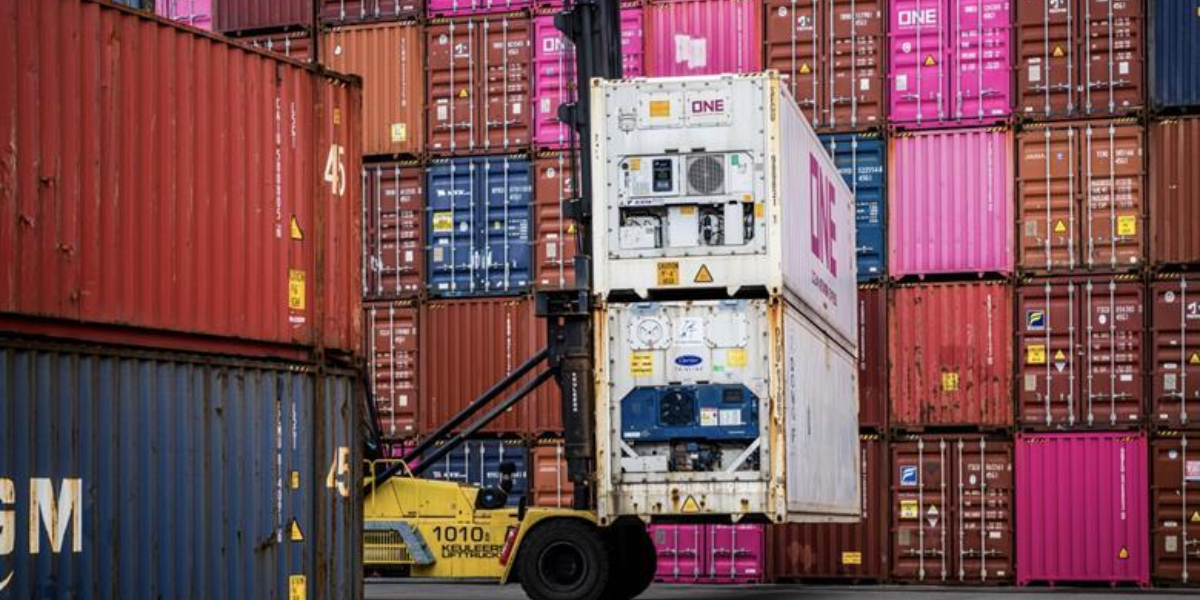
Antwerp (The Brussels Morning Newspaper) – October 9, 2026 – The Port of Antwerp-Bruges closed the annual trading period with stable container performance, recording throughput of 13.63 million twenty-foot equivalent units (TEUs) despite severe geopolitical disruptions, industrial strike actions, and terminal congestion. Container traffic grew by 0.7 per cent in TEUs and 0.4 per cent in tonnage, offsetting significant declines in bulk cargo segments. Total maritime freight throughput reached 266.5 million tonnes, representing a 4.1 per cent year-on-year drop driven by contractions in liquid and dry bulk. Major infrastructure and expansion projects, including the Extra Container Capacity Antwerp initiative, remain central to addressing operational bottlenecks and securing long-term logistics capacity.
Container Volumes Maintain Stability Despite Geopolitical Disruption
Container throughput at the Port of Antwerp-Bruges remained resilient throughout the year, consolidating its position as a central logistics hub for Western Europe despite significant global operational friction. Total container handling reached 13.63 million TEUs, marking a modest 0.7 per cent increase compared to the previous annual performance. Measured in weight, container cargo accounted for 149.5 million tonnes, reflecting a slight rise of 0.4 per cent year-on-year.
The stable performance was achieved against a background of ongoing maritime supply chain adjustments. Shipping lines continued rerouting vessels around the Cape of Good Hope to avoid conflict in the Red Sea, causing irregular vessel arrival patterns, larger call sizes, and extended dwell times at terminals. Dwell times for containers at port terminals averaged seven to eight days during peak periods, up from the baseline average of five days.
Furthermore, the restructuring of major container shipping alliances resulted in simultaneous vessel calls and sudden peaks in cargo volume. These operational spikes put terminal infrastructure under persistent operational strain, leading to localized landside congestion and reduced yard availability.
The port’s overall market share in the Hamburg–Le Havre port range slipped slightly to 29.3 per cent. Port officials attributed this slight decline to physical terminal capacity limitations rather than a contraction in market demand.
Divergent Performance Across Cargo Segments
While container handling demonstrated steady figures, total maritime freight throughput across all cargo categories at the port declined by 4.1 per cent, falling to 266.5 million tonnes. This decrease was primarily caused by substantial contractions in the liquid and dry bulk sectors.
Liquid bulk throughput experienced a steep fall of 12.9 per cent, finishing at 72.8 million tonnes. The contraction was influenced by market dynamics affecting refined oil products, naphtha, and liquid natural gas (LNG). European sanctions and shifting global trade routes following the implementation of restrictions on Russian energy products directly impacted LNG transshipment and storage activity in Zeebrugge. European industrial demand for chemical feedstocks remained under pressure, limiting chemical cargo movement and raw material imports.
Dry bulk cargo recorded a 12.1 per cent reduction, totalling 13.1 million tonnes. The loss was driven by the complete phase-out of Russian coal imports under European trade restrictions and lower demand for construction materials across North-Western Europe. However, fertilizer import volumes saw temporary increases, driven by trade flows preceding new tariff structures on agricultural inputs.
In contrast, non-containerised cargo segments posted positive growth. Roll-on/Roll-off (RoRo) traffic expanded by 3.0 per cent to reach 20.9 million tonnes. Growth in RoRo handling was supported by high volumes of heavy industrial equipment, commercial trucks, and second-hand vehicles, despite fluctuations in new car movements. China emerged as a prominent point of origin for automotive imports handled through Zeebrugge, while shipments of vehicles to North America were adjusted due to altered trade tariffs.
Conventional breakbulk cargo also recorded moderate growth, rising by 1.6 per cent to 10.2 million tonnes. Steel and iron traffic showed stabilization towards the second half of the year following tight European import quota regulations aimed at mitigating global steel production overcapacity.
Operational Challenges and Labor Movements
Throughout the operating year, maritime and terminal operations faced recurring disruptions. National labor actions and union strikes in Belgium affected port logistics across multiple months. Industrial actions linked to broader national debates on pension reforms and public service conditions resulted in an estimated 25 days of partial or full operational disruptions.
The cumulative impact of labor stoppages led to temporary diversions of vessel calls to alternative container hubs in the region. Port authorities estimated that labor disruptions and severe winter weather occurrences caused an estimated loss of 2.4 million tonnes in cargo throughput during the operating year.
Despite these interruptions, ship navigation numbers remained steady. A total of 20,236 seagoing vessels called at the Port of Antwerp-Bruges, representing a slight increase of 0.2 per cent. Cruise ship calls reached 166 vessels, delivering 466,089 passengers through the Zeebrugge cruise terminal facilities.
Infrastructure Expansion and Long-Term Capital Projects
To address existing capacity constraints and accommodate future fleet size increases, the Port of Antwerp-Bruges has accelerated work on major infrastructure and modernization plans. The cornerstone of the port’s long-term expansion strategy is the Extra Container Capacity Antwerp (ECA) project.
The ECA project encompasses the construction of a new tidal container dock alongside the optimization and deep-water conversion of existing terminal space along the River Scheldt. The expansion aims to add millions of TEU handling capacity to the port’s existing infrastructure, mitigating landside congestion and shortening container dwell times.
In addition to the ECA initiative, capital projects scheduled for implementation with funding support from the Flemish Government include:
-
The New Zeebrugge Lock: Construction of a second large sea lock in Zeebrugge to improve accessibility for deep-sea vessels and secure redundant access to the inner port facilities.
-
Terminal Digitalization: Implementation of expanded real-time tracking systems and landside gate scheduling to smooth truck traffic flow and lower peak terminal dwell times.
-
Energy Transition Infrastructure: Expansion of shore-power installations for docked vessels and green hydrogen distribution pipelines within the chemical cluster.