The European Commission has announced that it will provide €35m in humanitarian aid to war-torn Sudan.
The announcement came as EU and African Union leaders met in Angola and follows what the EU calls “continued pressure on relief operations across several crisis zones.”
The financial assistance for Sudan is part of an overall €143m aid package agreed by the EU leaders.
EU Commissioner for Equality, Preparedness and Crisis Management, Hadja Lahbib stated:
“The EU is stepping up at a moment when global attention is shifting and humanitarian needs remain high.
“This funding shows that we stay engaged in the places where pressure is rising and support is essential. We will keep holding the line alongside the partners who are working under the heaviest strain.”
A commission spokesman said,
“Several regions in Africa continue to face severe humanitarian pressure driven by conflict, displacement and declining access to basic services.
“These humanitarian crises have led millions of people to flee their homes to find safety. The EU remains a global leading donor in Africa, maintaining a steady humanitarian funding to the crises unfolding.
“The humanitarian assistance funded by the EU is delivered in partnership with UN agencies, international organisations and NGOs.”
Meanwhile, fresh comment has come from senior political figures in the EU about the dire crisis in Sudan.
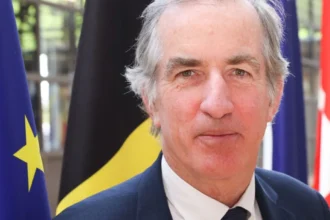
Speaking exclusively to this site on Tuesday (25 November) German MEP David McAllister, Chairman of the European Parliament’s Foreign Affairs Committee, said,
“The situation in Sudan has descended into one of the world’s gravest humanitarian catastrophes.”
The vastly experienced deputy added,
“After nearly three years of conflict, millions are displaced, famine is spreading, and civilians — especially women and children — are being subjected to horrifying levels of violence.”
The centre right member continued, “The capture of El Fasher and the atrocities that followed underline once again that both the SAF and the RSF, as well as those who enable them from the outside, bear direct responsibility for this tragedy.
“What Sudan needs now is an immediate end to hostilities, full humanitarian access, and a credible path back towards democracy. Europe must step up its humanitarian support for the Sudanese people and remain unwavering in demanding accountability for all violations of international and humanitarian law.”
Elsewhere, Denis MacShane, a former Europe Minister under Tony Blair in the UK, told this website,
“Europe whether as EU or individual nation states has not a policy for Africa – except keeping migrants at bay – worthy of its name. Sudan is a left-over from British colonial rule and the 19th century scramble for Africa.”
The former cabinet minister added,
“Africa is our closest neighbour as a continent and Europe collectively should develop a new combined security-economic growth-respect for human especially women’s rights policy.”
Further comment comes from Willy Fautré, director of the respected Human Rights Without Frontiers (Brussels).
He said,
“The Rapid Support Forces (RSF), part of Sudan’s Tasis Alliance, has taken control of El-Fasher. The defeat for the Sudanese Armed Forces (SAF) means that the entire Darfur region is now under RSF control, giving the RSF strategic leverage in negotiations.
“Capturing El-Fasher consolidates RSF dominance across all five Dafur states, severs the last military foothold of the SAF in the region, and opens up direct logistical corridors for RSF supply routes,”
he said.
He added,
“The control of El Fasher gives the RSF undisputed dominance over Darfur. It also further secures a logistical corridor to Libya for arms and fuel, and allows the redeployment of RSF forces to the main front lines. Peace is not for tomorrow.”
Meanwhile, a spokesman for the ECR group in the EU Parliament, one of the assembly’s mainstream political groupings, said,
“Sudan is facing one of the gravest humanitarian crises of this century.
“The ECR Group is deeply concerned by the political, ethnic and regional fragmentation of the country, and by the indiscriminate persecution of communities — including ethnic and religious minorities — who are bearing the brunt of the violence. Women and children are suffering most from this collapse of order.
“At this stage, the European Union must focus on what it can realistically do: use its diplomatic weight to press for de-escalation, access for humanitarian relief, and the conditions for a political settlement. Europe’s influence is greatest when it speaks with one clear, steady voice.”
Also commenting on the Sudan tragedy, former German Greens MEP Frank Schwalba-Hoth is critical of the EU, telling this site:
“The EU is considering Sudan not at all as a priority. Its recent text comes late and is not addressing pressure on the UAE, the main ally of the RSF.”