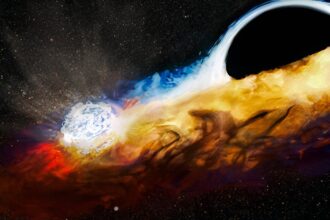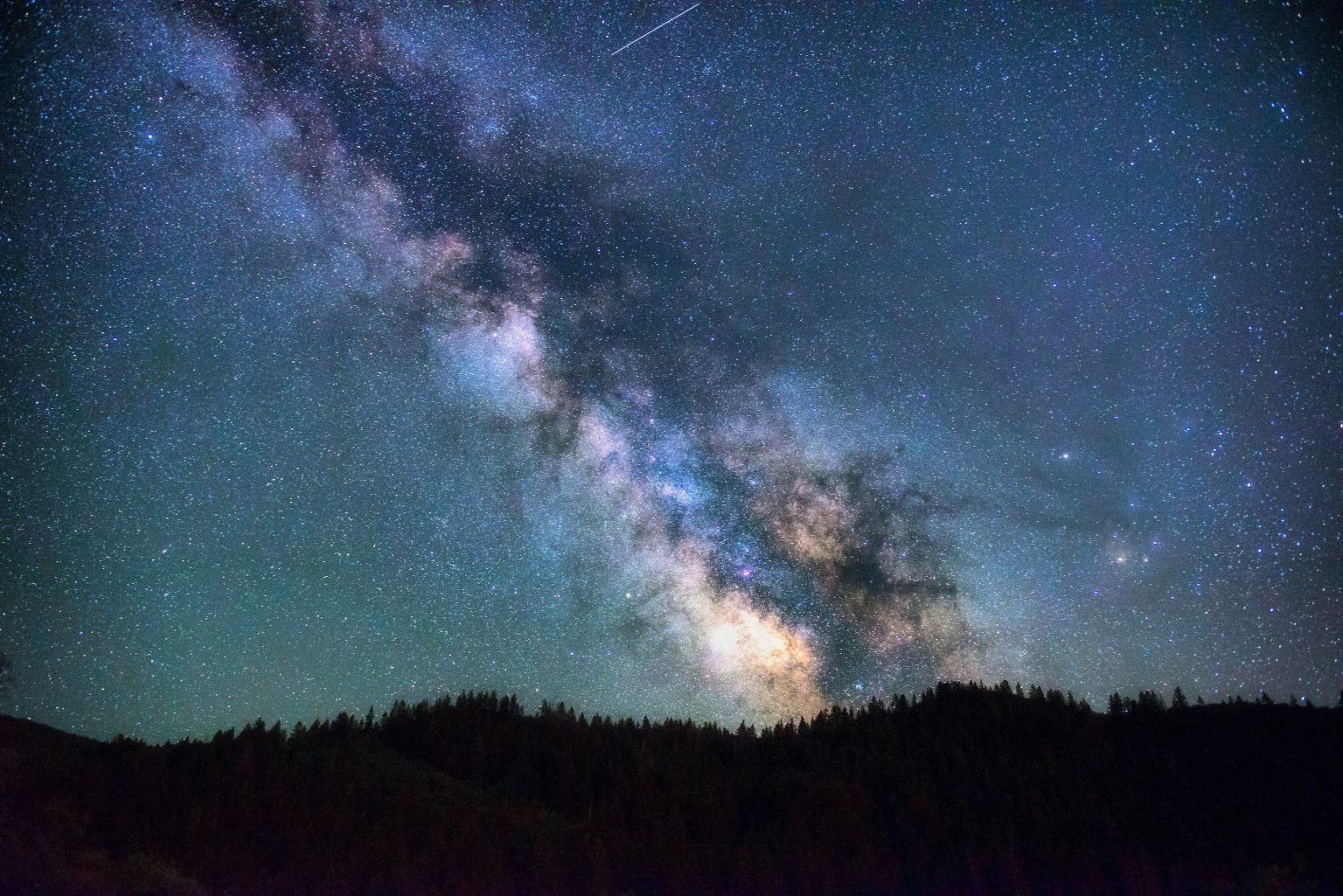
Global, 18 August (Brussles Morning Newspaper) The Milky Way swallowed a smaller galaxy around 11.8 billion years ago, leaving behind ancient star clusters that astronomers have now used to reconstruct one of the earliest major events in our galaxy’s history. Evidence of the Milky Way galaxy collision points to a merger when the universe was only about 1.5 billion years old, offering a rare glimpse of how our galactic home began taking shape.
The smaller system has been identified as Low-energy-Kraken-Heracles, or LKH, a name bringing together structures previously studied separately. Researchers say the evidence indicates they are remnants of the same ancient progenitor rather than necessarily the products of several unrelated events.
Milky Way galaxy collision traced through ancient stars
Astronomers did not observe the vanished galaxy directly. Instead, they found its fingerprints in globular clusters — densely packed groups containing some of the oldest stars still orbiting the Milky Way.
A research team led by astrophysicist Davide Massari examined the ages and chemical characteristics of these clusters. Three distinct age-metallicity sequences emerged from the analysis.
One is associated with stars formed within the Milky Way. Another is linked to Gaia-Enceladus, a galaxy known to have been absorbed later in the Milky Way’s history. The third pointed towards a substantially older merger.
The researchers estimate that LKH contained roughly 500 million solar masses in stars. Much of the material it contributed is now concentrated within the inner six kiloparsecs, or approximately 20,000 light-years, of the Milky Way.
Hubble observations uncover an ancient galactic fingerprint
Precise observations from the Hubble Space Telescope were central to the research, allowing astronomers to compare the relative ages of globular clusters closely enough to separate populations with different origins.
Information from the European Space Agency’s Gaia mission has also helped transform the study of the Milky Way by providing detailed measurements of the positions and movements of stars.
Together, such observations allow researchers to work backwards through billions of years of galactic evolution.
The findings support earlier suggestions that stellar structures described as Low-energy, Kraken and Heracles may share a common origin. Establishing that connection helps simplify a complicated part of the Milky Way’s early merger record.
What happened when the two galaxies met?
A galactic merger sounds catastrophic, but it does not mean hundreds of millions of stars physically crashing into one another.
The enormous distances between individual stars make direct stellar collisions comparatively unlikely. Instead, gravity rearranges stellar orbits as the galaxies combine. Their gas can interact much more strongly, potentially creating conditions that encourage new stars to form.
The Milky Way galaxy collision therefore represents a long process of gravitational disruption and absorption rather than a single moment of impact.
By the end of that process, the smaller galaxy had lost its separate identity. Its stars and clusters became part of the growing Milky Way.
Why the discovery matters
Scientists already know that mergers played an important role in building the Milky Way. Gaia-Enceladus is among the clearest examples, with its remains helping astronomers understand how our galaxy developed over cosmic time.
The newly identified event pushes evidence for substantial galactic growth further back.
That is important because the earliest period of the Milky Way’s history is particularly difficult to reconstruct. Billions of years of stellar movement have mixed populations together, gradually obscuring where individual stars originated.
Globular clusters offer a way through that problem. Their ages, chemistry and movements can preserve evidence that has disappeared elsewhere in the galaxy.
What astronomers will investigate next
Researchers can now look more closely for stars and clusters whose chemical composition and motion connect them to Low-energy-Kraken-Heracles.
Further observations could establish how much material the lost galaxy contributed to the Milky Way and clarify the part it played in forming the galaxy’s inner regions.
The research also demonstrates how much information remains hidden among the Milky Way’s oldest stars. Nearly 12 billion years after the smaller galaxy disappeared, its surviving stellar populations are still providing astronomers with clues to one of the earliest chapters in our galaxy’s history.