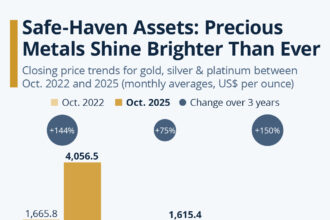

The global commodities landscape is undergoing a notable shift as investors increasingly turn toward precious metals. The gold market outlook has strengthened significantly, reflecting renewed confidence in gold as a store of value and a hedge against uncertainty. At the same time, silver has surged to fresh highs, reinforcing broader optimism across the metals complex.
This momentum is not driven by speculation alone. Instead, it reflects persistent inflation pressures, geopolitical risk, currency volatility, and long-term structural changes in the global financial system. Together, these forces are reshaping investor behavior and redefining how gold and silver fit into diversified portfolios.

Gold Prices Maintain Record Strength
Gold’s performance has captured global attention as prices remain near historic highs. The gold market outlook continues to benefit from strong demand among both institutional and retail investors who are seeking protection from economic instability.
Several key factors are supporting elevated gold prices:
- Ongoing inflation concerns across major economies
- Expectations of future interest rate adjustments
- Expanding government debt burdens
- Increased diversification away from fiat currencies
These drivers create a supportive environment where gold retains its appeal even as other asset classes experience volatility.
Silver’s Rally Reinforces Precious Metals Confidence
Silver has joined the rally with notable force, pushing prices to levels not seen in years. This development strengthens sentiment across the entire metals sector and further improves the gold market outlook.
Unlike gold, silver benefits from both investment demand and industrial usage. Growth in renewable energy, electric vehicles, electronics, and medical applications has significantly boosted silver consumption. As industrial demand converges with investor interest, silver’s breakout acts as confirmation that the precious metals rally is broad-based rather than isolated.
Inflation Pressures Continue to Support Metals
Inflation remains a central concern for global markets. While headline inflation has moderated in some regions, core price pressures persist, particularly in housing, food, and energy.
Gold has historically performed well during inflationary periods, preserving purchasing power when currencies weaken. This dynamic plays a critical role in sustaining the gold market outlook, especially as real interest rates remain low by historical standards.
When inflation erodes confidence in cash and fixed-income instruments, precious metals often become preferred alternatives.
Interest Rates and Monetary Policy Uncertainty
Central banks around the world are navigating a difficult balancing act between controlling inflation and supporting economic growth. This uncertainty has enhanced demand for assets perceived as stable and resilient.
Gold benefits when investors expect interest rates to peak or decline. Lower rates reduce the opportunity cost of holding non-yielding assets, which supports demand and reinforces the gold market outlook over both the short and long term.

Geopolitical Risk and Safe-Haven Demand
Global geopolitical tensions remain elevated, contributing to uncertainty across financial markets. Conflicts, trade disputes, and shifting alliances continue to disrupt supply chains and increase risk premiums.
During such periods, gold traditionally performs well due to its safe-haven status. Rising geopolitical risk strengthens the gold market outlook, as investors seek assets that are not tied to any single government or currency system.
Silver also benefits indirectly, particularly through increased demand linked to defense spending and infrastructure investment.
Currency Volatility and the Dollar Effect
Gold prices are closely linked to movements in global currencies, especially the US dollar. When the dollar weakens, gold often becomes more attractive to international buyers.
Factors contributing to currency volatility include rising fiscal deficits, growing debt levels, and uncertainty surrounding global trade. These dynamics support the gold market outlook, as investors look for alternatives that can retain value during periods of currency instability.
Central Bank Gold Accumulation
Central banks have emerged as major players in the gold market, steadily increasing their holdings in recent years. This trend reflects a strategic effort to diversify reserves and reduce exposure to geopolitical and currency risk.
Sustained central bank demand provides long-term structural support for prices and adds credibility to the gold market outlook. Unlike speculative flows, official sector purchases tend to be stable and persistent, helping to anchor the market during periods of volatility.

Investor Sentiment and Market Momentum
Investor psychology plays a critical role in sustaining market trends. As gold prices remain elevated, momentum continues to attract additional buyers.
Positive sentiment is reinforced by:
- Strong technical indicators
- Increased media coverage
- Portfolio rebalancing toward defensive assets
- Rising interest among retail investors
This momentum further enhances the gold market outlook, creating a feedback loop that supports continued strength.
Gold Compared With Other Asset Classes
Gold’s appeal becomes especially clear when compared with other investments. Equities can experience sharp corrections, bonds are sensitive to interest rates, and digital assets remain highly volatile.
Gold offers several distinct advantages:
- Low correlation with stocks
- No credit or counterparty risk
- Long history as a store of value
- Global liquidity
These characteristics strengthen the gold market outlook, particularly during periods of heightened uncertainty.
Short-Term Gold Market Outlook
In the near term, markets may experience consolidation as traders react to economic data and policy signals. However, most analysts view any pullbacks as healthy corrections rather than trend reversals.
Key short-term factors include inflation reports, employment data, and central bank communications. Despite potential volatility, the gold market outlook remains constructive due to strong underlying demand.
Long-Term Structural Drivers
Looking beyond short-term fluctuations, several structural trends continue to support precious metals. Rising global debt, aging populations, and geopolitical fragmentation are unlikely to reverse quickly.
Gold’s role as a reserve asset, inflation hedge, and portfolio stabilizer ensures ongoing relevance. These long-term dynamics contribute to a favorable gold market outlook that extends well beyond current market cycles.
Strategic Considerations for Investors
Investors often view gold as a strategic allocation rather than a speculative trade. Proper portfolio construction typically involves diversification across asset classes, with gold serving as a stabilizing component.
A disciplined approach focuses on long-term value rather than short-term price movements. This perspective aligns well with the current gold market outlook, which is supported by enduring macroeconomic forces rather than temporary trends.
The precious metals rally reflects deeper changes within the global economy. Inflation concerns, monetary policy uncertainty, geopolitical risk, and currency volatility have all contributed to renewed interest in gold and silver.
As gold holds near record levels and silver confirms the trend with its own breakout, the gold market outlook remains firmly positive. Supported by strong fundamentals and long-term demand, gold continues to play a critical role in modern investment strategies.