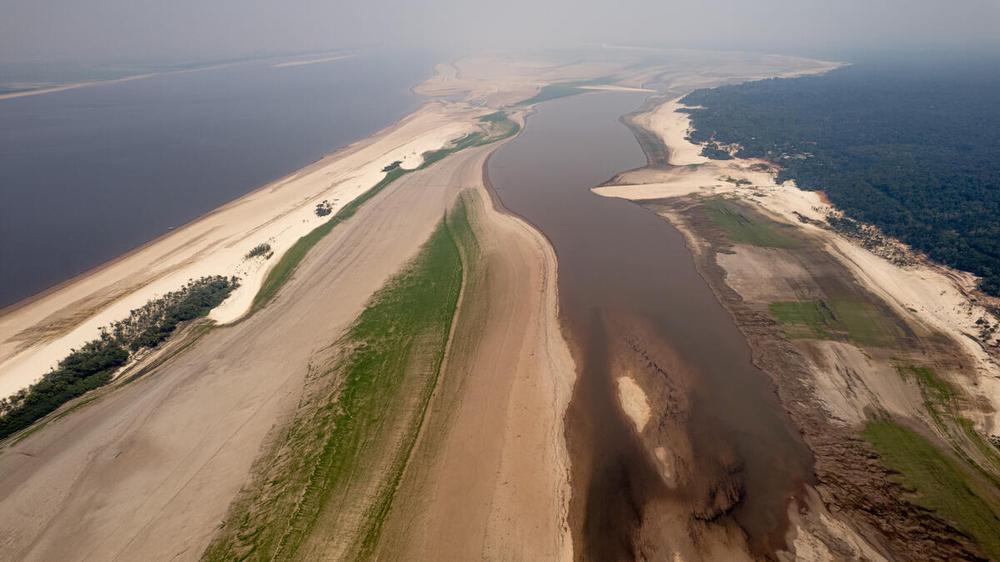
Brasília, Brazil, 17 August (Brussles Morning Newspaper) The risk of an El Niño Amazon drought is intensifying as climate forecasts indicate the Pacific warming event could become exceptionally powerful towards the end of 2026, threatening to deepen dry conditions, lower river levels and increase wildfire danger across parts of the world’s largest tropical rainforest.
The latest assessment from the US National Oceanic and Atmospheric Administration’s Climate Prediction Center, issued on 13 August, says El Niño is strengthening and has a greater than 90% chance of becoming a “very strong” event during the Northern Hemisphere autumn and winter of 2026-27.
The timing is particularly concerning for northern Brazil. Dry conditions in the Amazon can persist well into the latter part of the year, while El Niño tends to suppress rainfall across northern South America. Previous strong events have been associated with severe Amazon drought and damaging fire seasons.
El Niño Amazon drought risk rises towards late 2026
NOAA reported that sea-surface temperature anomalies exceeded 2°C in the eastern equatorial Pacific during its latest assessment. For October to December, its forecast gives a 69% probability of an event strong enough to exceed previous El Niño episodes in the agency’s record dating to 1950.
The World Meteorological Organization has separately forecast rapid intensification. Its July seasonal update projected a strong event during August to October, with the multi-model average continuing upwards and peaking around November.
Brazilian authorities are already preparing for the consequences. The country’s environment ministry said in July that experts saw an increased risk of forest fires between August and October, particularly across the Amazon, Cerrado and parts of central-western Brazil.
Brazilian agencies warn of heat, drought and fires
Brazil’s National Institute of Meteorology said on 31 July that projections showed El Niño strengthening throughout the second half of the year, with a high probability of reaching very strong intensity between the Southern Hemisphere spring and early summer.
Forecasts from Brazilian agencies have also indicated below-average rainfall across much of the country’s centre and north, alongside above-average temperatures. That combination can dry vegetation and make fires easier to start and harder to control.
NOAA explains that El Niño can disrupt Amazon rainfall because unusually warm waters shift tropical atmospheric circulation across the Pacific. Air descending over northern South America can then inhibit the convection responsible for rainfall.
Why the Amazon’s vulnerability matters globally
A severe El Niño Amazon drought would extend beyond an environmental emergency for Brazil. Falling rivers can disrupt transport and isolate communities, while drought threatens agriculture, fisheries and water supplies. Reuters reports that northern and western Brazil face heightened drought and heat risks as the developing event reshapes weather across Latin America.
Forest fires add another danger. Drought-stressed rainforest becomes more vulnerable when agricultural or land-clearing fires escape into surrounding vegetation. Burning and forest degradation also release stored carbon, weakening the Amazon’s role in regulating the global climate.
The risks are especially serious for Indigenous and riverside communities whose food, drinking water, transport and livelihoods depend heavily on healthy forests and navigable waterways.
What happens next?
Scientists will closely monitor Pacific temperatures, Amazon rainfall, river levels and fire conditions over the coming months. NOAA’s next formal ENSO diagnostic assessment is scheduled for 10 September.
The precise severity of the El Niño Amazon drought cannot yet be known. NOAA stresses that even an exceptionally strong El Niño does not guarantee typical effects in every region. But with the phenomenon strengthening as the Amazon moves through a climatically vulnerable period, Brazilian authorities have clear reason to prepare for heightened drought and wildfire risks before conditions potentially worsen later this year.