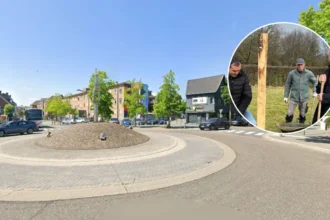

Bilzen-Hoeselt (Brussels Morning Newspaper) – Bilzen-Hoeselt plans to remove right-of-way at 30 intersections. The Goosstraat–Romershovenstraat junction in Hoeselt has been updated, with new signs installed to improve traffic safety and clarity.
As VRT News reported, the city of Bilzen-Hoeselt, in the province of Limburg, Belgium, is changing traffic rules at around 30 intersections to improve safety and clarity on local roads. One of the main updates is on the route from Hoeselt to Schalkhoven via Goosstraat.
Until recently, drivers on Goosstraat had to yield to traffic from Romershovenstraat. That rule has now been removed, according to Het Belang van Limburg. Officials say the old priority no longer matched daily traffic and often caused confusion at a junction where sightlines were limited.
What changes are coming to the right-of-way at 30 Bilzen-Hoeselt intersections?
Alderman for Mobility Yves Croux confirmed that the right-of-way has been taken out and that new road signs have been placed at the intersection. Several crossings will now follow the standard right-before-left rule.
“I pass by there regularly, and I can tell you from personal experience that you only dared to take that right of way at the risk of your own life,”
says Crow.
“Because on the main road, the speed limit is 70 kilometers per hour, and on Romershovenstraat, it’s 50 kilometers per hour.”
The city’s traffic committee will study around 30 more intersections next year to decide if the right-of-way rule can be removed there as well.
“These are all intersections of streets with different speed limits, and it won’t become a general rule. We’ll look at each intersection individually,”
the alderman emphasises.
This plan follows a wider trend in Flanders, where more municipalities have dropped right-of-way rules in recent years. Local authorities say the change often leads to calmer traffic and fewer sudden conflicts at smaller junctions.
“At many intersections, this is safer,”
says Stef Willems of the Vias Traffic Institute.
“For example, on heavily trafficked roads where other roads connect. Especially if the speed limit on those main roads is higher.”
“In a residential area, on the other hand, with streets with the same speed limit, it is logical that priority from the right is maintained,”
Willems concludes.
A lot of Flemish towns and cities are doing away with their old traffic regulations. They experienced many difficulties as a result of these old regulations being confusing. Glabbeek is one of those municipalities that has adopted a completely different traffic regulation where they have created a more clearly defined and signposted system in regards to who has the right of way at intersections. Measurements have indicated that Glabbeek has had fewer accidents at smaller intersections than they did under their prior method of traffic regulations.