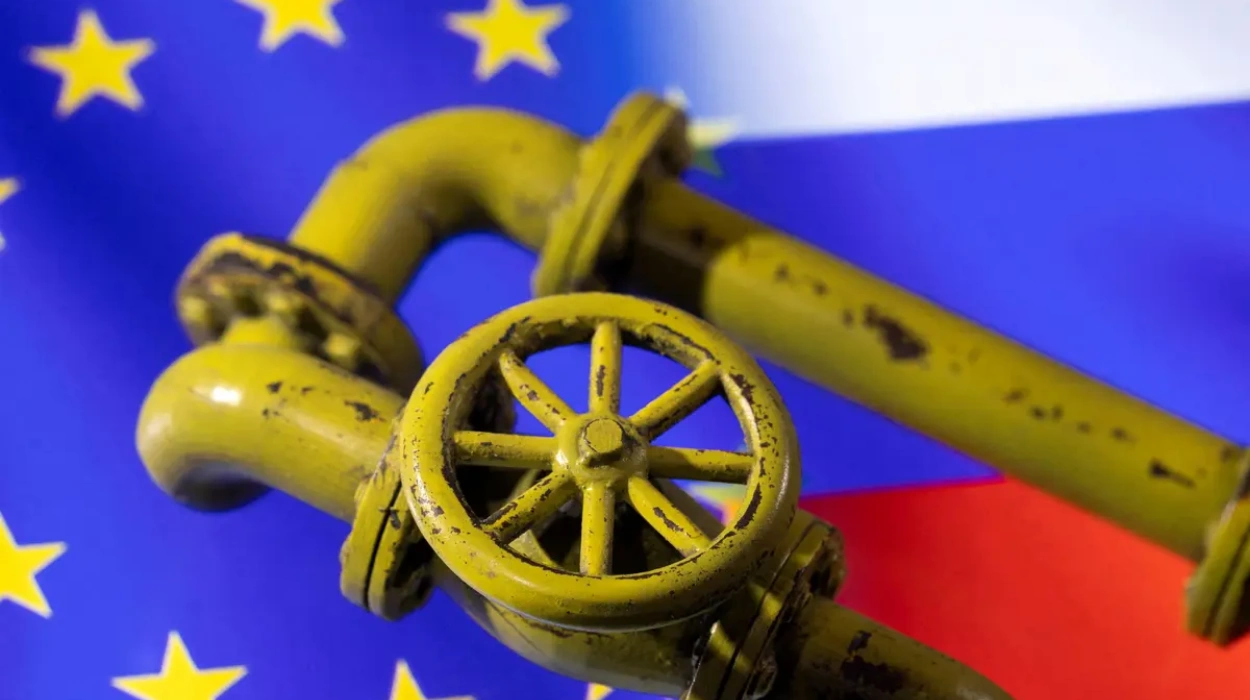
Brussels (Brussels Morning Newspaper) – The European Council announced on Wednesday that it had reached an agreement with the European Parliament to phase out Russian gas imports by 2027, part of the broader effort to eliminate reliance on Russian energy.
The agreement will establish a legally binding, phased ban on importing liquefied natural gas (LNG) and pipeline gas from Russia, with complete bans starting by the end of 2026 and autumn 2027, respectively.
‼️DEAL: @EUCouncil and @Europarl_EN reached an agreement on phasing out Russian gas imports by 2027.
— EU Council Press (@EUCouncilPress) December 3, 2025
The regulation will contribute to ending any dependency on Russian gas and strengthening the EU's energy security.@eu2025dk
More here 👇
“We’ve made it: Europe is turning off the tap on Russian gas, forever,” EU Energy Commissioner Dan Jorgensen wrote on X. “
We’ve chosen energy security and independence for Europe. No more blackmail. No more market manipulation by Putin. We stand strong with Ukraine.”
Deal on #REPowerEU!
— Dan Jørgensen (@DanJoergensen) December 3, 2025
We've made it: Europe is turning off the tap on Russian gas, forever.
We've chosen energy security and independence for Europe.
No more blackmail. No more market manipulation by Putin.
We stand strong with Ukraine.
The European Parliament announced that the legislation plans a phased ban on Russian liquefied natural gas imports starting in 2026, with a full ban on pipeline gas to follow by September 30, 2027. The regulation also specifies the highest penalties that member states must impose on operators for non-compliance.
How will the EU enforce its phased Russian gas ban?
Under the agreement, long-term pipeline contracts will be prohibited starting from September 30, 2027, if storage levels are adequate, and no later than November 1, 2027.
Long-term contracts for liquefied natural gas (LNG) will be banned starting January 1, 2027, following a request by Commission President Ursula von der Leyen to strengthen sanctions against Moscow.
Short-term contracts will be eliminated earlier: starting April 25, 2026, for LNG and June 17, 2026, for pipeline gas.
The move aims
“to end dependency on Russian energy following Russia’s weaponisation of gas supplies with significant effects on the European energy market,”
said a European Council statement. Furthermore, the lawmakers called for a ban on Russian oil imports and concurred with the European Commission to develop a legislative proposal early next year, aiming to prohibit Russian oil by the end of 2027 at the latest.
How will member states diversify gas supplies by 2027?
The regulation mandates that all member states submit national diversification plans, outlining how they plan to diversify gas sources and the challenges they anticipate, with the goal of ceasing all Russian gas imports within the set deadlines.
The council and parliament retained the “suspension clause,” enabling the regulation to be temporarily halted if unforeseen events jeopardize the energy supply of one or more member states.
Rules about when the commission can lift the import ban have become more restrictive, permitting it only in critical situations, such as when a member state declares an emergency, and only for a limited duration and short-term supply agreements.
How does the agreement align with broader EU sanctions policy?
In reaction to Russia’s invasion of Ukraine, the European institutions imposed gradual bans on Russian energy imports beginning in 2022, mainly through a series of sanctions packages that targeted coal, oil, and gas.
Although pipeline gas imports persisted, they were subject to indirect restrictions, such as prohibitions on services for Russian LNG projects or particular terminals unrelated to pipelines, restrictions on EU gas storage for Russian-origin supplies, and bans on new investments in Russian energy. Liquefied natural gas (LNG) imports saw bans on transhipment via EU ports and new contracts in later proposals, with REPowerEU accelerating diversification.