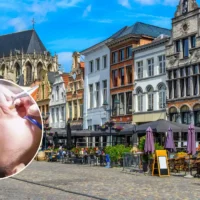

Sint-Niklaas (Brussels Morning Newspaper) – This morning, Nov 12, 2025, Sint-Niklaas police served coffee and cake at Stationsplein to promote their youth program, led by full-time youth officer Anthony Huck, who also manages the police Instagram.
As VRT News reported, this morning, Nov 12, 2025, a police car with a small caravan was parked in the square, not for patrol duty, but to offer coffee, hot chocolate, and cake. Officers talked with young people passing by and invited them to a chat.
“The first reaction when people see police is often aversion,”
says Sara Goossens, youth coordinator with the Sint-Niklaas police department.
“They think: ‘Oh dear, police.’ We hope that today we can show that we don’t always have to be here to take action, but also to be there for the young people.”
How are Sint-Niklaas police using coffee and social media to connect with youth?
The Sint-Niklaas police said the meeting is part of their work to build stronger contact with young residents. It adds to regular police work by focusing on prevention and personal contact. Goossens works to reach young people who are not easily approached through normal police actions.
“Repression is often used, and young people sometimes end up in a negative light because of their nuisance,”
says Goossens.
“But there’s also a large group of young people who are very difficult to reach. That’s why it’s important that we also focus on presence and accountability.”
Since November 2025, Anthony Huck has joined the Sint-Niklaas police as the city’s first full-time youth officer. His job is to be present where young people gather and to connect with them in a simple, informal way.
“Anthony is sent out to places where young people are, to be there too,”
said youth coordinator Goossens.
He talks with young people on the streets, at events, and in public areas. Huck also works online by managing the police’s Instagram account.
“I will personally answer the messages we receive there,”
says Huyck.
“That way, we also want to offer a listening ear. Through social media, we want to be easily accessible to young people who are harder for us to reach.”
“I strongly believe in this project,”
says the youth officer.
“Over the past few weeks, I’ve played football with them and made house calls, among other things. I’ll soon become a familiar face to them at Stationsplein and De Witte Molen sports hall, among other places.”
During a recent protest, the police chose to wear their full uniforms.
“We want to give the uniform a positive connotation,”
says Goossens.
“So young people know they can just talk to us if they see us on the street, and that they don’t have to be afraid of us.”
He mentioned that the reactions were mostly positive. Many young people stopped to have coffee and talk with officers. Some also started following the police on Instagram.
“We want to show that we’re there for them too,”
concludes the youth coordinator.
The police in Ghent and Antwerp, engaged with youth in more relaxed environments, such as parks or public squares, or schools. Sometimes, when officers had a chance to find the youth, a copule drinks or small activities may have provoked informal conversations. In 2023 in Leuven, the police were conducting a program titled Police on the Spot, where police engaged with youth in recreational areas and used social media to check up on or remain in contact with youth.