Mongolia’s president has resigned over corruption claims a day after the EU welcomed the country into its flagship security forum, putting the newly forming relationship in question.
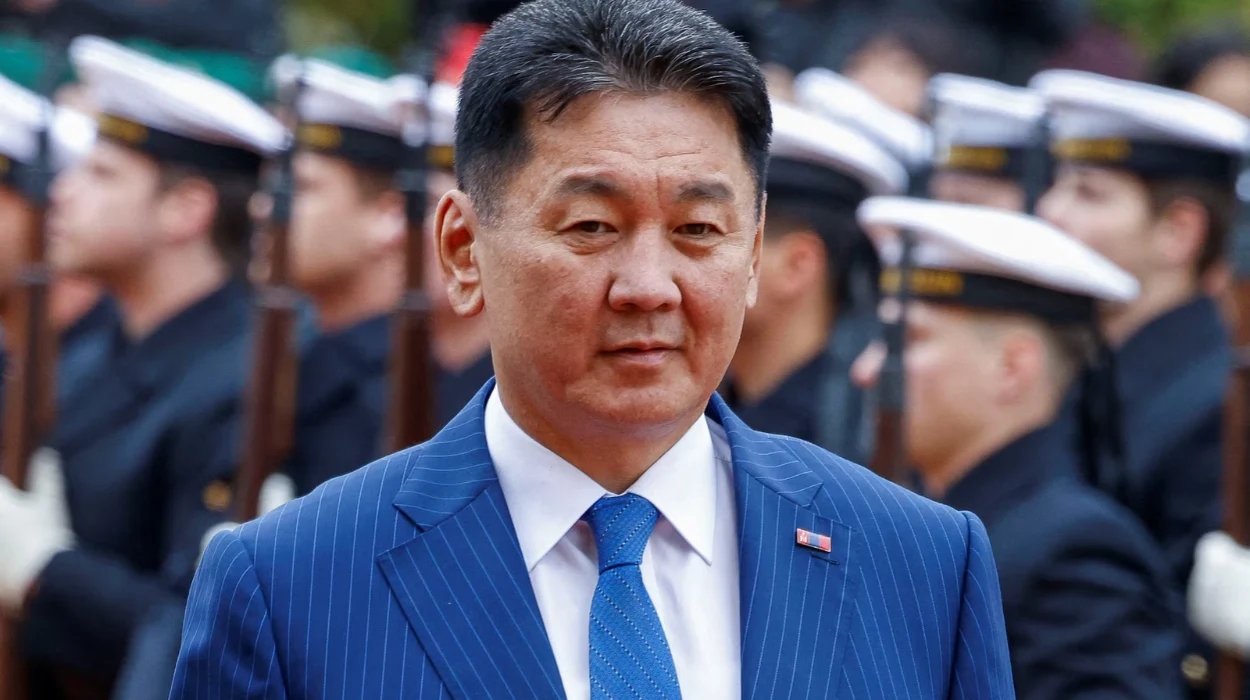
Mongolia’s President Khurelsukh Ukhnaa announced on Tuesday that he plans to resign, following corruption allegations and the threat of impeachment. Less than twenty-four hours prior, the EU welcomed the country into its flagship security forum, flagging energy independence as one of country’s main security challenge.
If parliament accepts Khurelsukh’s resignation, Mongolia must hold an election within four months. That would leave Brussels seeking closer security ties with a country in the middle of a bitter dispute within its ruling party. This year’s shortages showed how quickly a disruption in Russia, Mongolia’s main fuel supplier, can leave drivers queuing for petrol. A prolonged fight over the succession could slow eJorts to secure supplies elsewhere, leaving Mongolia exposed when Russian deliveries tighten again.
Russia supplies most of Mongolia’s fuel, and China took nearly nine-tenths of its exports in 2025. That dependence is why Mongolia has long courted “third neighbours” such as the EU, a policy Brussels reaffirmed its support for in June, and why Europe has returned the interest. Germany became the first EU member state to sign a strategic partnership with Mongolia in 2024, and President Frank-Walter Steinmeier hosted Khurelsukh in Berlin just four weeks ago.
For Europe, the reward is access to minerals. Copper is already Mongolia’s largest export, and its first rare earth projects are nearing production. A strong relationship would help the EU lessen its dependence on China. For that, however, the EU itself said in June that a “stable, predictable and reliable” business environment was “crucial”. Khurelsukh’s resignation over corruption claims puts that at risk.
Why the President Resigned
Khurelsukh’s resignation is the culmination of a power struggle within the ruling Mongolian People’s Party (MPP). It has followed allegations from, former Ulaanbaatar mayor Khishgeegiin Nyambaatar, who belongs to a rival faction of the MPP and is a longtime associate of former prime minister Oyun-Erdene.
Nyambaatar alleges that Khurelsukh secured a railway contract for Bodi International without a competitive tender in 2019, when he was prime minister, and took $25 million from the company, claims both Khurelsukh and Bodi deny.
The opposition Democratic Party seized on the allegations, demanding that Khurelsukh step down or face impeachment. On Tuesday, he denied wrongdoing, saying he would cooperate with investigators and was stepping down to “restore my good name”.
Nyambaatar himself has reportedly fled to Canada. In September, Investigators charged him with abuse of power whilst abroad, over an allegedly unlawful payment to the contractor building Ulaanbaatar’s Tuul Expressway. He denied taking any of the project money and called the case politically motivated. In October, Mongolia’s Anti-Corruption Agency requested an Interpol Blue Notice to help locate him.
The timing is significant. Khurelsukh’s single six-year term was due to end in 2027, and limits prevent him from standing again. Oyun-Erdene’s faction has claimed that figures close to the President were pushing for him to stay on, which his office has repeatedly denied One Mongolian academic has already suggested the resignation could be a power play that leaves Khurelsukh free to seek another office later.
If parliament accepts Khurelsukh’s resignation, Speaker Sandagiin Byambatsogt will take over as acting president and an election must be held within four months. Bringing the election forward would add to the upheaval in the ruling Mongolian People’s Party, which has already seen three changes of government in ten months.
Allegations of corruption
The allegations are the latest in a series of corruption scandals to shake Mongolia. In 2022, revelations that up to $11 billion in coal exports had been siphoned oJ through the state coal company sparked the country’s largest protests in decades. In 2024, fuel importer Lex Oil was found to be at the centre of a $1.1 billion fraud. That scandal reached the presidency too: the Defence Ministry, led by the minister now set to become acting president, paid Alpha Aurora Aviation, a company founded by a former Lex Oil shareholder, to fly Khurelsukh in 2024.
The Implications for Europe and Mongolia as a Strategic Partner
Brussels is already grappling with Mongolia’s economic ties to Moscow. In July, the EU included Mongolia’s Chinggis Khaan Bank in its Russia sanctions package. Now the infighting and corruption claims that put Mongolia’s reliability in doubt have brought down its head of state. Brussels wanted a partner with stable rules and less need for Russian fuel. Four weeks after its president returned from Berlin, Mongolia looks further from both.