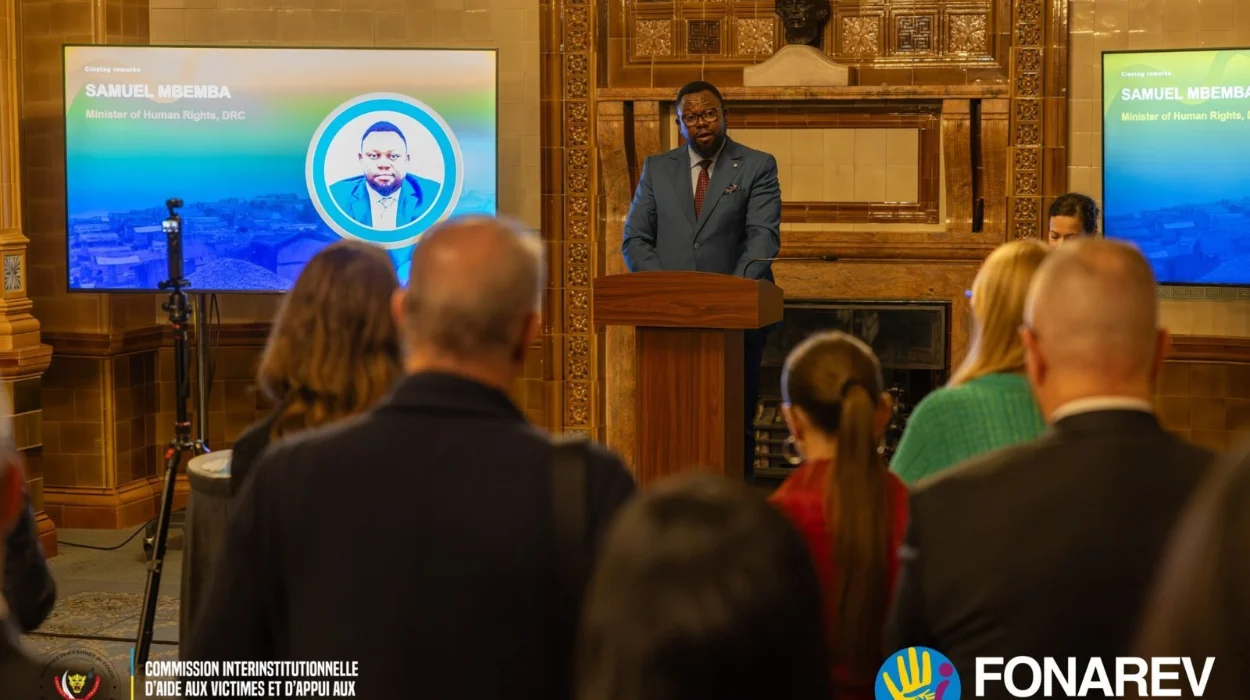
Parliamentarians, diplomats, legal experts, academics and civil society representatives from across Europe, gathered at the National Liberal Club last night to hear how the UK can help the Democratic Republic of Congo move towards peace and justice for survivors of violence.
Labour peer Baroness Helena Kennedy KT KC delivering the keynote address telling the room:
“Congo hardly gets a headline in a newspaper. It’s one of those things we should feel shame about.”
She detailed how Britain is the penholder on women, peace and security and therefore
“this is a moment when Britain’s voice could be heard — and heard more loudly. We should be demanding that it is.”
In the audience notable guests included parliamentarians Baroness Sarpong, Baroness Bennett of Manor Castle, Bishop of Winchester Philip Mountstephen, former Ambassadors Diane Corner and Tim Morris, and author Michela Wrong. The room heard from Baroness Kennedy’s calls for the UK to support the International Criminal Court’s investigation into alleged war crimes and crimes against humanity in eastern DRC and parallels with other conflicts that have received more accountability.
The event 1996-2026: Women, Violence and Justice within the DRC was organised by FONAREV (National Fund for Victim Reparations) and CIA-VAR (Interministerial Commission for Victim Assistance and Reform Support) to mark 30 years since the outbreak of the First Congo War. Since the 1990’s, between 250,000 – 1 million women have been raped in eastern Congo, and 40% of those victims are children.
His Excellency Mr. Samuel Mbemba Kabuya, Minister of Human Rights for the DRC, told the room about the present day violence carried out by M23:
“Sadly the truth is that even as we stand here tonight, in the east of Congo, women and children are being terrorised by forces supported by the Government of Rwanda. I would urge all in this room to ask your Government to join others in the condemnation of Rwanda.”
Patrick Fata Makunga, Director General of FONAREV told the audience that
“a child was reported raped every thirty minutes.”
FONAREV has identified more than 250,000 victims, mainly in the eastern provinces, and between 2025 and 2026 compensated more than 5,500 of them. In North and South Kivu, it has worked with partners to provide reconstructive surgery for women and girls with fistula, and post-rape kits for every health area in the two provinces. It has also helped 2,710 women back into work, 1,478 of them survivors of sexual violence.
Alongside this work, FONAREV and CIA-VAR are backing a change.org petition urging the international community to acknowledge three decades of atrocities in the DRC. It draws on the principle of “Genocost”, a term written into Congolese law in December 2022, which recognises that these crimes were committed for economic purposes through the illegal exploitation of the country’s natural resources. The petition has gathered almost 200,000 signatures so far.
Closing her keynote, Baroness Kennedy urged the audience not to look away:
“I want us to be calling for access to justice. And I really do think a moment in time has come where Britain, with a different commitment from the British Foreign Secretary, that now is the time for calling out what’s happening.”
To sign the petition, click here.