New amendments tabled in the European Parliament’s Committee on Agriculture and Rural Development (AGRI) reopen the debate on how plant-based foods may be named and marketed.
Mainstream products such as instant noodles, crips and soups could fall within the scope of new EU rules reserving flavour descriptors such as “chicken” and “bacon” for animal products.
The rules come barely three months after the European Union adopted rules reserving 31 meat-related terms for animal products. Regulation (EU) 2026/1739, published in the Official Journal on 29 July 2026 as part of a package designed to strengthen the position of farmers in the food supply chain, protects the term “meat” alongside 31 related names, including “beef”, “pork”, “chicken”, “steak”, “breast” and “drumstick”. The regulation entered into force on 18 August, with its meat-designation provisions applying from 19 August 2029.
Although the legislative debate has centred on plant-based meat alternatives, the rules may reach considerably further into the supermarket. Industry representatives have warned that “chicken” and “bacon” flavour descriptors used on mainstream noodles, crisps, sauces and soups could be caught, since many such products contain no meat.
The question has drawn particular attention in the United Kingdom, where the Food Standards Agency has indicated that Britain would be bound by the new labelling requirements under prospective alignment agreements with the EU, unless negotiators secure exemptions for specific products.
Amendments published by the Agriculture Committee on 23 July 2026, tabled by members of the European People’s Party, Patriots for Europe and European Conservatives and Reformists groups, would extend protection beyond the 31 terms already adopted.
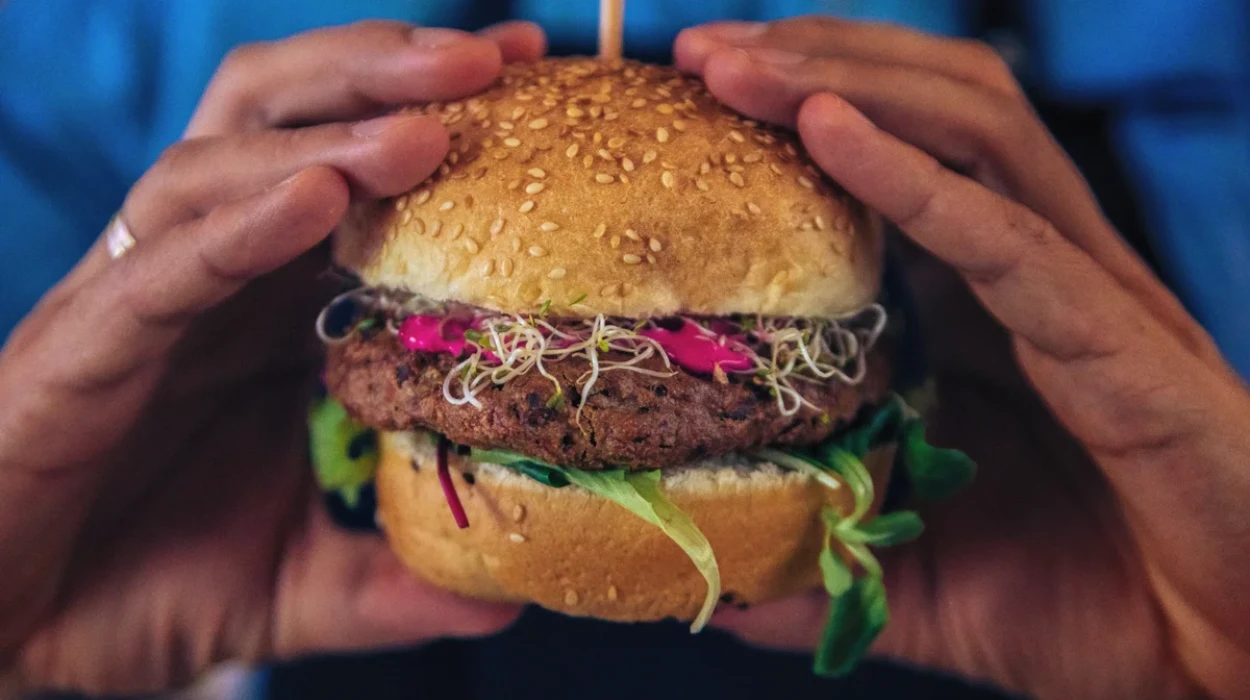
The most far-reaching text, tabled by French EPP lawmaker Céline Imart, would reserve a broad group of processed-meat names for animal products, including “burger”, “sausage”, “salami”, “ham”, “meatball”, “nugget” and “schnitzel”. The committee debated the proposals on 2 September, with a vote scheduled for December and a plenary vote expected in 2027.
Legislative debate on how a product may describe its flavour are not without precedent in the EU. The 2016 Tobacco Products Directive barred packaging elements on tobacco products that refer to taste, smell or flavourings, five years after the initial public consultation on the directive opened in 2010.
For manufacturers, a wider list would mean further relabelling and rebranding obligations. US producer Beyond Meat has already flagged the proposed changes as a regulatory risk in a filing with the US Securities and Exchange Commission. The European Alliance for Plant-based Foods and the No Confusion Coalition, which represents more than 600 companies, retailers and civil society organisations across 22 member states, have rejected the proposals. Critics also point to an October 2024 ruling by the Court of Justice of the European Union, which struck down a similar French measure and found existing EU food information rules sufficient to protect consumers.
The renewed push for naming restrictions coincides with an institutional focus on easing the regulatory load on European companies. The European Commission has placed simplification at the heart of its competitiveness agenda, setting a target to reduce administrative burdens by at least 25% for all businesses and at least 35% for small and medium-sized enterprises, representing expected savings of €37.5 billion by 2029. Presenting its 2026 work programme, the Commission pledged to “cut administrative burdens by 25% overall and 35% for SMEs”.
The food sector has been included in that drive. The Commission presented Omnibus X on food and feed safety on 19 November 2025, while Parliament last week adopted Omnibus VI Chemistry, part of a broader series of measures intended to simplify business operations within the European Union.
Plant-based producers have argued that the naming proposals sit uneasily with these objectives. The European Alliance for Plant-based Foods has contended that the amendments harm the EU’s strategic priorities, and campaigners have cited a conflict with the Commission’s EU Protein Action Plan, published on 7 July.
Beyond this it seems like a further example of EU overreach, wrong priorities and nanny state.