
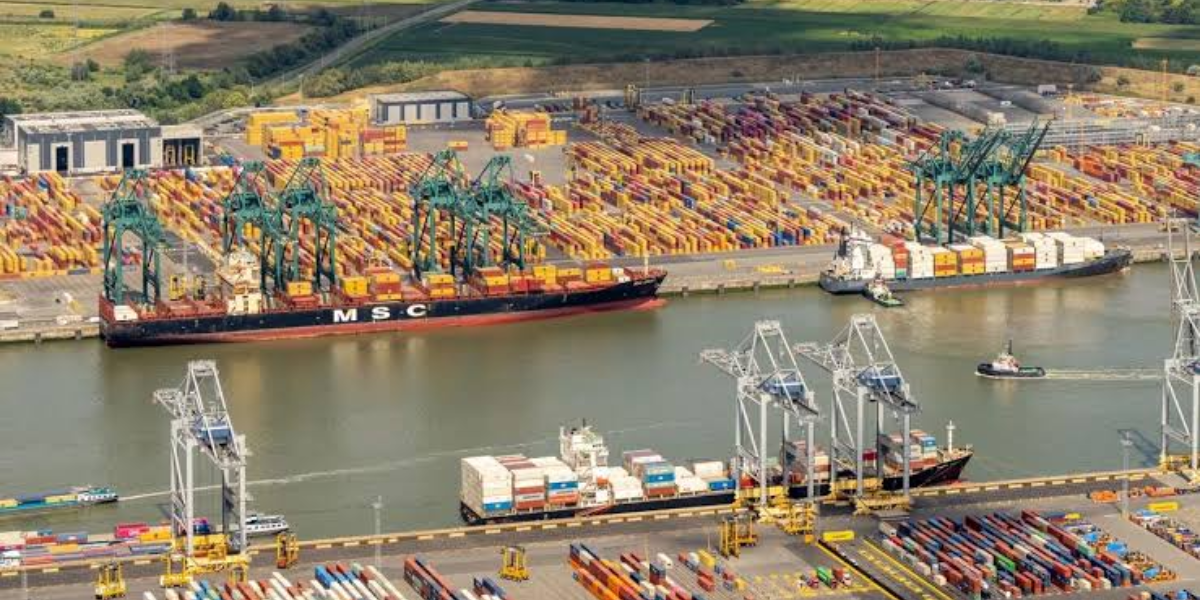
Antwerp (The Brussels Morning Newspaper) July 23, 2026 – Bunkering sales at the Port of Antwerp-Bruges recorded a 5.5 per cent year-on-year increase in total sales volume during the second quarter of 2026, driven by a strong rebound in Very Low Sulphur Fuel Oil demand. Total volumes for conventional marine fuels and biofuels reached approximately 2 million metric tonnes over the three-month period. The growth was further supported by double-digit percentage gains in High Sulphur Fuel Oil and Ultra Low Sulphur Fuel Oil off-take. However, total biofuel bunker sales experienced a year-on-year contraction despite a sequential quarterly recovery, while Liquefied Natural Gas bunkering posted a moderate decline.
The Port of Antwerp-Bruges, one of Europe’s largest maritime refuelling hubs, has published its official second-quarter bunkering metrics, demonstrating sustained demand growth for marine fuels across the Northern European shipping corridor. Total volumes of conventional marine fuels and bio-blended alternatives supplied across the port’s facilities in Antwerp and Zeebrugge reached roughly 2 million metric tonnes ($2,000,000\text{ mt}$) between April and June 2026. The headline figure represents a 5.5 per cent increase compared to the corresponding period in 2025, buoyed by expanding vessel calls and shifting fuel procurement strategies among major ocean carriers operating in the North Sea and English Channel.
The performance across individual fuel categories revealed notable divergences, with conventional oil-based marine fuels accounting for the vast majority of total volume gains while alternative fuel segments displayed mixed trajectories.
Very Low Sulphur Fuel Oil and Heavy Fuel Demand Surge Across Northern Europe
The rebound in overall bunker volumes was primarily driven by standard low-sulphur distillate and residual fuel grades, which remain the primary energy sources for the global merchant shipping fleet. Sales of Very Low Sulphur Fuel Oil ($\text{VLSFO}$), which complies with the International Maritime Organization’s 0.50 per cent global sulphur cap, recorded a 12.8 per cent year-on-year increase during the second quarter. The growth in $\text{VLSFO}$ volumes reflects stable regional trade flows and competitive price benchmarks in the ARA (Amsterdam-Rotterdam-Antwerp) bunkering complex.
Simultaneously, High Sulphur Fuel Oil ($\text{HSFO}$) sales climbed 11.6 per cent year-on-year to reach 659,182 metric tonnes. The continued strength in $\text{HSFO}$ consumption highlights the expanding installed capacity of exhaust gas cleaning systems ($\text{scrubbers}$) across container ships, bulk carriers, and tankers operating on major international trade routes. Scrubber technology allows shipowners to burn lower-cost, high-sulphur residual fuel while remaining compliant with regional and international sulfur emission mandates.
Ultra Low Sulphur Fuel Oil ($\text{ULSFO}$), which contains a maximum sulphur content of 0.10 per cent to satisfy strict Sulphur Emission Control Area ($\text{SECA}$) requirements in the North Sea and English Channel, recorded the highest relative percentage growth among traditional fuels. Sales of $\text{ULSFO}$ surged by 43.6 per cent year-on-year during the quarter, reflecting intensified short-sea shipping activity and regional feeder vessel operations within Northern European waters.
| Fuel Category | Q2 Performance & Volume Statistics | Year-on-Year Change (%) |
| Total Conventional & Biofuels | ~2,000,000 metric tonnes | $+5.5\%$ |
| High Sulphur Fuel Oil (HSFO) | 659,182 metric tonnes | $+11.6\%$ |
| Very Low Sulphur Fuel Oil (VLSFO) | Major total sales share | $+12.8\%$ |
| Ultra Low Sulphur Fuel Oil (ULSFO) | High-growth SECA fuel | $+43.6\%$ |
| Biofuels | Partial recovery from Q1 | $-36.0\%$ |
| Liquefied Natural Gas (LNG) | 76,513 metric tonnes | $-13.4\%$ |
Biofuel Market Dynamics and Regulatory Shifts Influence Procurement
In contrast to conventional residual and distillate fuels, sustainable marine fuel categories experienced varying commercial conditions throughout the second quarter. Total biofuel sales delivered at Antwerp and Zeebrugge decreased by 36 per cent compared to the same quarter of the previous year. Despite this year-on-year contraction, biofuel volumes demonstrated a 29 per cent sequential rebound when compared to the first quarter of 2026.
Industry participants note that biofuel bunkering patterns in Northern Europe have been significantly influenced by regulatory adjustments and incentive realignments across neighboring port jurisdictions. Specifically, the implementation of the Renewable Energy Directive ($\text{RED III}$) in the Netherlands affected cross-border pricing competitiveness and blending economics between the Dutch bunkering hubs of Rotterdam and the Belgian ports of Antwerp and Bruges. Furthermore, compliance strategies tied to the European Union Emissions Trading System ($\text{EU ETS}$) for maritime transport and the upcoming $\text{FuelEU Maritime}$ regulations continue to shape long-term procurement planning for bio-blended marine fuels.
Alternative Fuels Performance and Liquefied Natural Gas Trends
Liquefied Natural Gas ($\text{LNG}$) bunkering activity at the Port of Antwerp-Bruges saw a moderate reduction in total throughput during the second quarter. Total $\text{LNG}$ bunker deliveries dropped to 76,513 metric tonnes, representing a 13.4 per cent decline compared to the same period in 2025. The dip follows a historic high in $\text{LNG}$ sales recorded across the port complex throughout 2025, driven by the rapid expansion of dual-fuel container vessels and specialized carrier fleets.
Meanwhile, market data confirmed that no commercial methanol bunkering operations were recorded at the port during the second quarter. The port authority had previously logged its last dedicated methanol bunkering event in the third quarter of 2024, as ocean carriers continue to evaluate supply chain availability, safety protocols, and commercial pricing structures for alternative zero-carbon and low-carbon feedstocks. The port authority maintains operational frameworks and case-by-case guidelines to support methanol, ammonia, and hydrogen bunkering as fleet adoption evolves.
Mandatory Mass Flow Meters standardise Operations Across Antwerp and Rotterdam
The second-quarter figures represent the second full quarter of bunkering operations under mandatory Mass Flow Meter ($\text{MFM}$) regulations. Effective 1 January 2026, the port authorities of Antwerp-Bruges and Rotterdam made certified $\text{MFM}$ measuring systems compulsory on board all bunker vessels delivering residual fuels, distillates, and biofuels within their port waters.
The joint regulatory framework was introduced following independent industry studies, including research conducted by CE Delft, which identified recurring quantity discrepancies and measurement inconsistencies during manual fuel deliveries. The automated system measures the exact mass of fuel transferred from the bunker barge to the receiving vessel, enhancing operational efficiency, transparency, and market trust across the regional refuelling sector. Under the active permit system, port supervisors conduct unannounced inspections and random checks to enforce compliance, with non-compliant operators subject to financial penalties or licence revocations.