BRUSSELS, October 16, 2026
At the EU Summit Europe Steps Up Pressure on Russia, Accelerates Ukraine’s EU Bid Amid Energy and Migration Crises also.
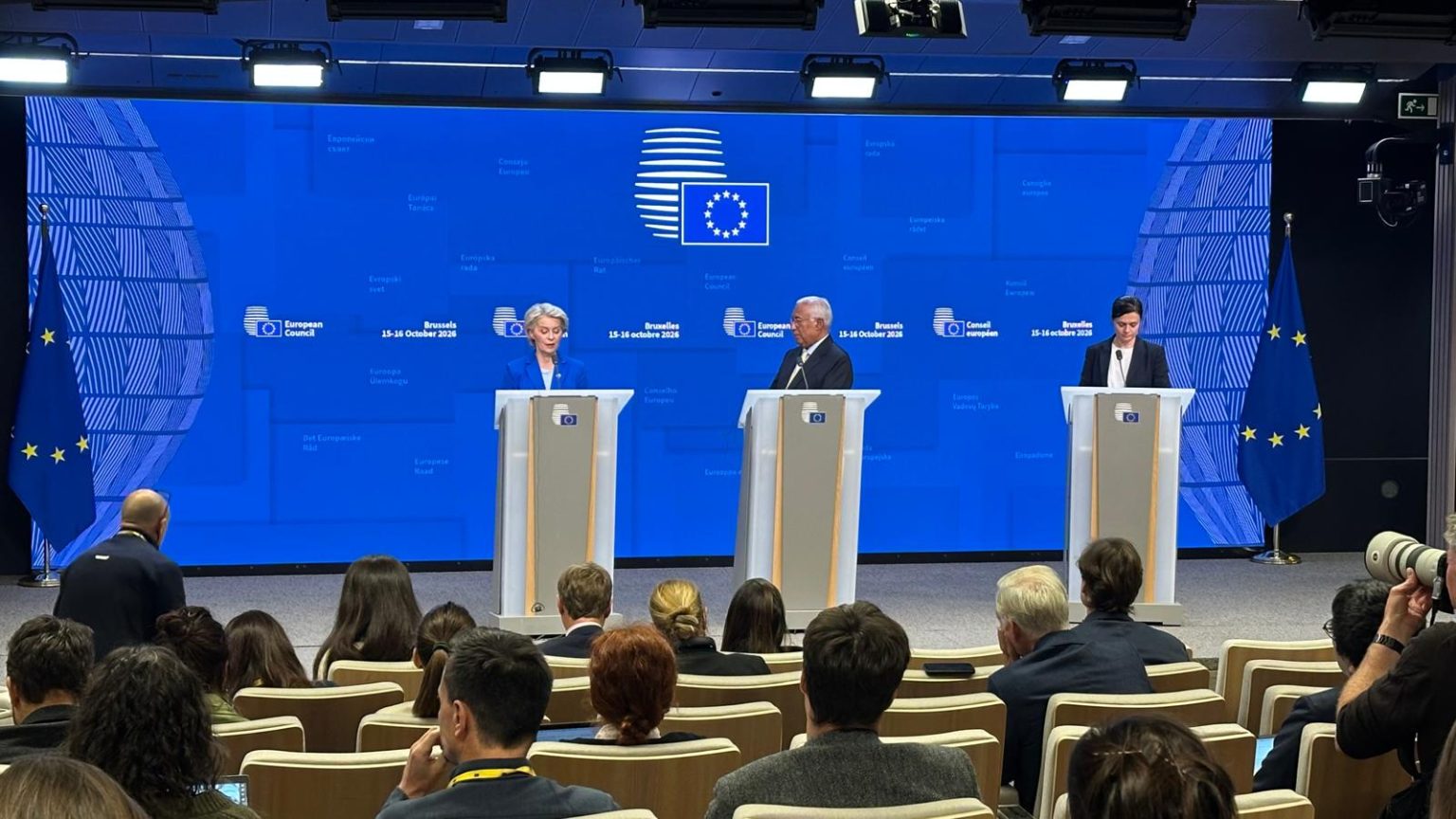
European Union leaders have pledged stronger support for Ukraine, accelerated progress towards EU membership and coordinated action to address soaring energy prices, while seeking common ground on migration and Europe’s economic competitiveness following a two-day European Council summit in Brussels.
European Council President António Costa reaffirmed the bloc’s commitment to Kyiv, warning that Russia’s escalating aggression and hybrid operations against EU member states require greater pressure on Moscow and stronger European defence.
“Our commitment to peace goes hand in hand with more pressure on the aggressor. Not less,” Costa said, confirming that EU leaders want to address Ukraine’s additional financing needs for 2027 and ensure continued support for its defence.
Ukraine’s EU accession gains momentum
Alongside financial and military support, Ukraine’s path towards EU membership gained momentum after Hungary lifted its veto on opening further negotiating clusters. Two additional clusters were opened, while the remaining two are expected by the end of the year.
The European Commission announced a joint EU-Ukraine task force to accelerate accession reforms, particularly on the rule of law and anti-corruption. EU and Ukrainian officials will meet twice a week over the coming months to help Kyiv meet key membership benchmarks.
The task force will focus on outstanding requirements under the fundamental areas of accession, including judicial and rule-of-law reforms and the fight against corruption. These interim benchmarks must be met before Ukraine can begin closing individual negotiating chapters.
The development follows an agreement on legislation concerning the rights of the Hungarian minority in Ukraine’s Transcarpathia region. Ukraine’s parliament adopted the legislation by a broad majority, and President Volodymyr Zelenskyy signed it, helping pave the way for Hungary to lift its veto.
European Commission Enlargement Commissioner Marta Kos said Ukraine was among the countries making the most progress towards EU membership. The task force follows a model previously used for Montenegro and Moldova, giving Kyiv’s accession process additional momentum.
The Commission is also expected to provide Ukraine with a roadmap outlining the main steps and an indicative timeline for accession as part of a broader enlargement package expected in early November.
Zelenskyy, who attended the European Council summit, also defended Ukraine’s right to strike Russian targets, including oil refineries, in response to Moscow’s invasion.
Asked by Euronews about US President Donald Trump’s criticism of his approach to negotiations, Zelenskyy said dealing with Trump was easier than dealing with Russian President Vladimir Putin.
“I’ve had several meetings with the President of the United States of America, and we always find topics for discussion and decision-making,” Zelenskyy said.
“I defend the interests of Ukraine and the Ukrainian people exclusively. We were attacked, occupied, and our people were killed. It is only logical that we have the right to defend ourselves,” he added.
Energy prices put pressure on European households and businesses
Energy affordability was another major concern at the summit. Costa warned that high and volatile energy prices were putting intense pressure on European households and businesses, exposing the EU’s continued dependence on fossil fuels and the absence of a fully integrated energy market.
He said the crisis was being driven partly by developments beyond Europe’s borders, but also reflected the bloc’s structural dependence on imported fossil fuels.
Given the urgency, EU leaders agreed on the need for a coordinated European response and short-term measures to address the immediate economic impact. Costa stressed that accelerating the energy transition remained essential to strengthening Europe’s strategic autonomy and long-term resilience.
European Commission President Ursula von der Leyen also outlined measures to address rising energy costs following the summit.
She said the cost of imported fossil fuels had increased by approximately €106 billion since the start of the war in the Middle East, while gas prices had risen by around 140% and diesel prices had doubled.
The proposed measures include releasing 100 million barrels of oil and diesel over four months, extending temporary state-aid flexibility for businesses, postponing implementation of the methane regulation by one year and strengthening joint energy purchasing.
The Commission also plans to encourage investment in renewable energy, nuclear power and electricity grids, alongside efforts to strengthen European refining capacity and reduce dependence on imported fossil fuels.
The measures aim to ease immediate pressure on households and industry while accelerating Europe’s transition towards more secure and sustainable energy sources. However, disagreements remain over the scope of intervention and how best to balance short-term economic relief with longer-term climate objectives.
Migration: EU considers new emergency framework
Migration remained another major issue for European leaders. Costa said irregular border crossings into the European Union had fallen to their lowest level since 2021, arguing that the EU’s system, based on the Pact on Migration and Asylum, was producing results.
However, he stressed that the system still needed improvement, particularly in addressing the instrumentalisation of migrants and responding to exceptional situations at the EU’s external borders.
Leaders expressed openness to several proposals outlined in von der Leyen’s recent letter on migration, including the development of a new European emergency framework.
Von der Leyen also called for stronger European border management and proposed measures to reinforce Frontex and improve the EU’s capacity to respond to serious migration crises.
Costa acknowledged that migration remained a politically sensitive issue on which member states held different views. He nevertheless argued that common European solutions were essential to achieving results.
Trade, competitiveness and the EU’s next long-term budget
Beyond Ukraine, energy and migration, EU leaders reviewed progress on the “One Europe, One Market” agenda, aimed at strengthening the bloc’s competitiveness and economic resilience.
Costa highlighted progress on reducing administrative burdens, removing barriers within the single market and directing European private capital and savings towards European businesses.
He also welcomed the agreement reached on the Market Integration and Supervision Package, describing it as an important step towards a genuine capital markets union.
On the proposed “EU Inc” framework, intended to establish a common European regime for companies, Costa said leaders had agreed on concrete targets and timelines but stressed the need to maintain ambition and accelerate implementation.
Trade diversification was another priority. Costa said EU member states were united in supporting faster efforts to diversify trade partnerships, pursue dialogue with trading partners and strengthen the bloc’s defensive trade instruments.
He emphasised that trade negotiations must deliver concrete and timely results, while reaffirming the European Commission’s role as the EU’s trade negotiator.
Leaders also discussed the EU’s next long-term budget for 2028–2034, with the aim of concluding negotiations by the end of 2026.
Costa welcomed the Irish Presidency’s work in advancing negotiations and said the discussions had demonstrated leaders’ engagement with the process.
He stressed that national contributions must remain at a reasonable level while preserving the resources needed to meet shared European priorities. Developing new EU revenue sources, known as “own resources”, will be central to reaching an agreement, he said.
Europe’s defence and strategic autonomy
The summit also addressed growing security threats linked to Russia’s war against Ukraine. Costa warned that Moscow was intensifying hybrid campaigns across Europe, including acts of sabotage and repeated violations of member states’ airspace and territorial waters.
He said these actions would not go unanswered and reaffirmed the EU’s determination to accelerate implementation of its defence strategy by 2030.
European leaders also underlined the importance of reducing dependence on external energy suppliers, strengthening the European industrial base and improving the bloc’s ability to respond to geopolitical crises.
Costa announced a new informal meeting of EU leaders in Alden Biesen, Belgium, in early February 2027. The meeting, dubbed “Alden Biesen 2”, will follow up on previous discussions on defence and competitiveness, assess progress and seek to renew political momentum.
The summit highlighted the EU’s challenge of maintaining unity while addressing Russia’s war against Ukraine, economic pressures, energy insecurity and divisions over migration. Leaders now face the task of translating their commitments into concrete measures on security, economic resilience and Europe’s long-term strategic priorities.