Bruges (The Brussels Morning Newspaper) – October 9, 2026 – Construction work is due to begin this month on eight new wind turbines at the Port of Zeebrugge in Belgium, adding 42.6 megawatts of renewable electricity generation capacity. The project is a joint investment by ENGIE, Port of Antwerp-Bruges and Portfineco, which is jointly owned by Zefier and the port authority. The turbines are expected to generate approximately 115 gigawatt-hours of renewable electricity annually from early 2028, equivalent to the average electricity consumption of around 33,000 Belgian households. Three turbines will be installed at the Wallenius Wilhelmsen vehicle terminal, while five will be located at International Car Operators (ICO).
- Where Will the Eight New Wind Turbines Be Installed?
- How Much Renewable Electricity Will the Project Generate?
- When Will Construction Finish and Electricity Generation Begin?
- Which Companies and Organisations Are Financing the Project?
- How Have Environmental Assessments Addressed Wildlife and Local Impacts?
- What Does the Development Mean for Zeebrugge’s Existing Port Infrastructure?
- Background: How Does the Project Fit Into Belgium’s Renewable Energy Expansion?
- What Is the Expected Next Stage for the Zeebrugge Wind Turbine Project?
The development will expand wind power generation within one of Belgium’s major port and logistics areas. ENGIE will undertake the construction works and manage the turbines on behalf of Seagull I, the joint project company established for the development. Installation of the turbine towers, nacelles and blades is scheduled for the second half of 2027, ahead of the planned start of electricity generation in early 2028.
Where Will the Eight New Wind Turbines Be Installed?
The eight turbines will be distributed across three locations within the port, covering the sites of the Wallenius Wilhelmsen and International Car Operators vehicle-handling terminals. The installations will have a combined generating capacity of 42.6 megawatts (MW), with different turbine models selected for the designated locations.
At the Wallenius Wilhelmsen terminal on Alfred Ronsestraat, also identified as the N350, three Vestas V150-6.0 MW turbines are planned. Each will have a rotor diameter of 150 metres and a maximum tip height of 200 metres.
The remaining five turbines will be installed at ICO, divided between the Southern Inlet Dock and Northern Inlet Dock. Two Vestas V150-6.0 MW turbines will be installed at the Southern Inlet Dock, while three Vestas V136-4.2 MW turbines are planned for the Northern Inlet Dock.
The V136-4.2 MW models will have rotor diameters of 136 metres and tip heights of 180 metres. These specifications mean the new installations will introduce large wind turbines across several areas of the port rather than concentrating all eight at a single terminal.
The project details were published by Port of Antwerp-Bruges and supported by engineering consultancy Sweco Belgium, which assisted with permitting, environmental studies and technical preparation.
How Much Renewable Electricity Will the Project Generate?
The eight turbines are expected to produce approximately 115 gigawatt-hours (GWh) of renewable electricity annually once they begin operating. According to the project partners, that output is equivalent to the average annual electricity consumption of approximately 33,000 Belgian households.
The household comparison is based on an average annual electricity consumption of 3,500 kilowatt-hours per household. It provides an indication of the project’s expected generating scale, rather than confirming that the electricity will be supplied directly to 33,000 specific homes.
The new installations will add 42.6 MW of capacity to the port’s renewable energy infrastructure. Their annual output will depend on operational conditions and wind availability, so the published 115 GWh figure is an estimate of expected production.
The development also builds on existing wind generation at ICO. ENGIE, ICO and Portfineco commissioned an 11-turbine wind farm at the site in 2020, with a combined capacity of 44 MW. The new project will therefore expand wind generation at a terminal that already accommodates a substantial wind energy installation.
The project partners have not announced a specific investment amount in the information published about the development.
When Will Construction Finish and Electricity Generation Begin?
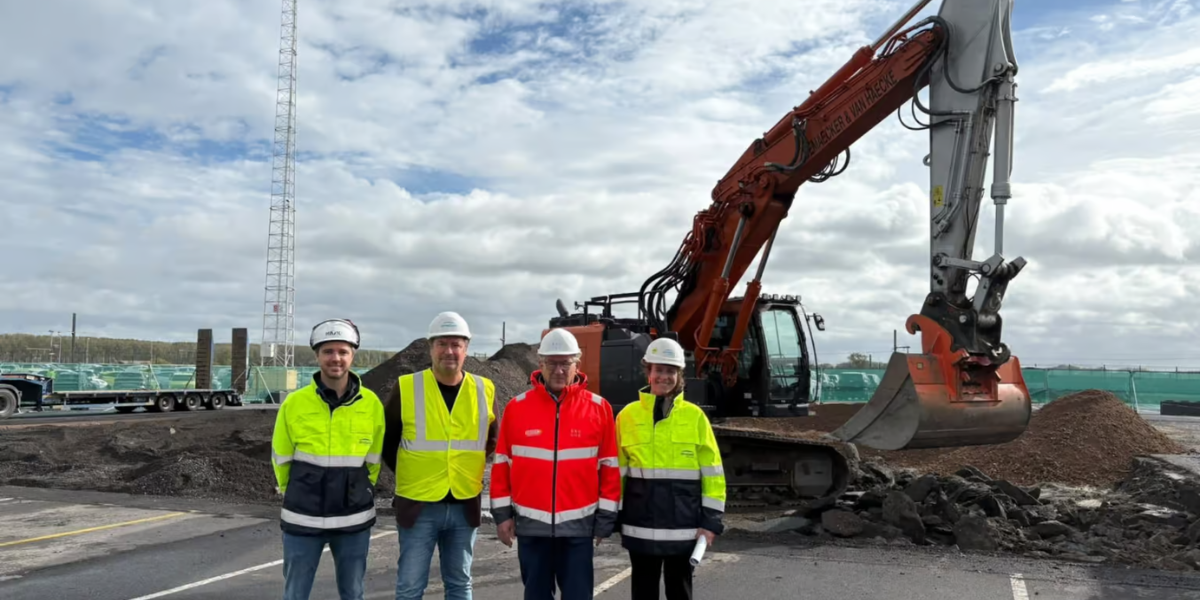
Preparatory groundworks and civil engineering work are scheduled to begin in October 2026. ENGIE will lead the construction phase, while the physical installation of the turbines is planned for the second half of 2027.
That stage will involve erecting the tower masts and installing the nacelles and rotor blades. The turbines are expected to become visible on the Zeebrugge skyline as these structures are assembled.
The project partners anticipate that renewable electricity generation will begin in early 2028. Once operational, the turbines are expected to produce approximately 115 GWh annually.
Sweco Belgium said the project had progressed through permitting, environmental assessment and technical preparation, with the required permits finalised before implementation. Its work included support for environmental permit applications, ecological assessments, structural studies, access roads and other construction preparations.
The published schedule distinguishes between the installation period in the second half of 2027 and the planned start of electricity production in early 2028. The partners have not specified a precise commissioning date for each turbine in their announcement.
Which Companies and Organisations Are Financing the Project?
The development is being undertaken through a joint investment by ENGIE, Port of Antwerp-Bruges and Portfineco. The latter is owned equally by Zefier and Port of Antwerp-Bruges.
ENGIE will oversee the turbines’ operational management on behalf of Seagull I, the joint project company responsible for the development. The arrangement brings together an energy company, the port authority and partners involved in renewable electricity investment.
Vincent Verbeke, chief executive of ENGIE Belgium, said the company operated 217 wind turbines in Belgium, representing 611 MW of capacity. He identified ports and industrial areas as important locations for expanding large-scale renewable electricity generation.
Verbeke also said the Zeebrugge development would strengthen the port’s role as a regional energy hub.
Dirk De fauw, vice-chairman of Port of Antwerp-Bruges and mayor of Bruges, said the project would increase the contribution of wind power to the port’s energy supply. He also referred to the port authority’s ambition to reach 500 MW of installed wind capacity across its platforms by 2030.
Henk Kindt, chairman of Zefier, welcomed the organisation’s participation through Portfineco and highlighted its involvement in renewable energy projects intended to benefit citizens.
The statements were included in the project announcement published by Port of Antwerp-Bruges on 9 October 2026.
How Have Environmental Assessments Addressed Wildlife and Local Impacts?
Environmental considerations formed part of the preparatory work for the new wind turbines, according to Sweco Belgium, which supported ENGIE during the planning and permitting stages.
Sweco said the assessment paid particular attention to nature and biodiversity because the port area is home to large gull populations during certain periods of the year.
The consultancy’s work included examining existing information and conducting field research across different seasons. Its ecologists mapped bird migration routes, resting areas and feeding grounds in the Zeebrugge region.
The work also included collision-risk modelling for the winter period. This examined the planned turbines alongside existing wind installations and considered the combined effects of turbine locations and gull flight movements.
According to Sweco, the findings can inform measures such as adjusting turbine positions to avoid busy flight paths and temporarily stopping turbines during periods of particularly high bird activity.
The consultancy also identified shadow flicker, noise and lighting as issues to be addressed during operation, with measures intended to minimise their effects on the surrounding environment.
These details describe the environmental planning and mitigation measures reported by Sweco. They do not establish that all potential environmental effects have been eliminated.
What Does the Development Mean for Zeebrugge’s Existing Port Infrastructure?
The project will add renewable electricity generation to a port that combines maritime transport, vehicle logistics, industrial activity and commercial operations.
Port of Antwerp-Bruges operates the port platforms at Antwerp and Zeebrugge. Its wider operations include the movement of vehicles, containers and other cargo, alongside industrial and logistics activities.
The new turbines are planned specifically for vehicle terminal premises operated by Wallenius Wilhelmsen and ICO. Five turbines will be located at ICO, which already has the 11-turbine wind farm commissioned in 2020.
The development therefore represents an expansion of renewable generation within an established logistics environment. The project’s stated output and household comparison indicate its expected electricity production, but the published announcement does not specify how all the electricity will be allocated among individual terminal operations, other port users or the wider electricity system.
The port authority has linked the project to its objective of increasing installed wind capacity to 500 MW by 2030. The eight new turbines will contribute 42.6 MW towards that stated ambition.
ENGIE’s operational role will continue beyond construction through its management responsibilities for Seagull I.
Background: How Does the Project Fit Into Belgium’s Renewable Energy Expansion?
The Zeebrugge development forms part of wider efforts by energy companies and port authorities to increase renewable electricity production in industrial and logistics locations.
ENGIE reported that it had 611 MW of installed wind capacity across 217 operational turbines in Belgium at the time of the announcement. Zefier, a municipal holding company established in 2017, also participates in renewable energy projects. By mid-2026, it held interests in 118 operational wind turbines with a combined nominal capacity of 360 MW, as well as 72,408 solar panels with an installed peak capacity of 20.9 MWp.
The port authority’s strategy includes expanding wind generation on its port platforms while maintaining its role as a major European trade and industrial hub. The Zeebrugge project brings together that objective with the partners’ plans to develop additional renewable electricity capacity.
The existing 44 MW ICO wind farm provides a local precedent for wind generation at a vehicle terminal. The eight additional turbines will extend that infrastructure across three locations, subject to the published construction and commissioning timetable.
The project’s announced figures, including its expected annual production, installed capacity and anticipated commissioning period, were released by the project partners on 9 October 2026.
What Is the Expected Next Stage for the Zeebrugge Wind Turbine Project?
The next scheduled stage is the start of civil engineering and preparatory groundworks in October 2026, followed by turbine installation in the second half of 2027. The partners expect electricity generation to begin in early 2028.
The principal milestones identified in the published information are the completion of construction preparations, erection of the turbine structures, installation of the nacelles and blades, and the start of commercial operation.
The project is expected to add 42.6 MW of wind generation capacity and produce around 115 GWh of renewable electricity annually once operational. Its contribution to the port authority’s 2030 wind capacity objective will depend on delivery of the announced project and the wider development of other wind installations across its platforms.