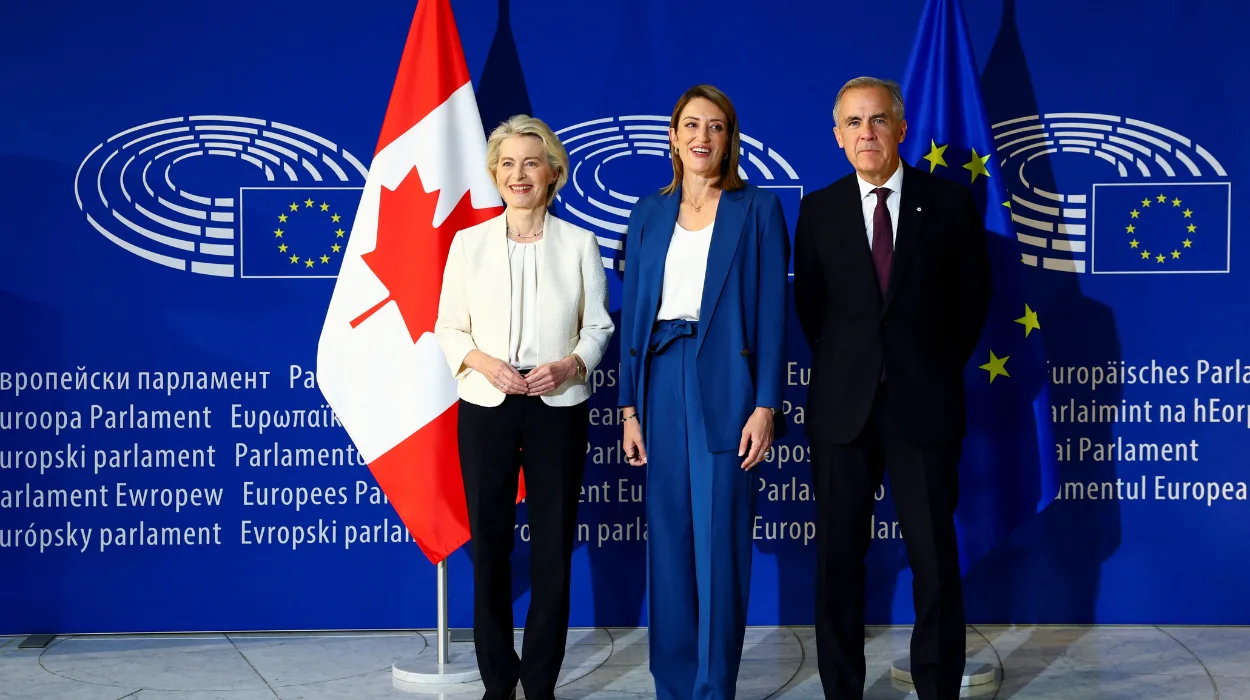
Brussels (Brussels Morning Newspaper) September 26, 2026 – European Commission President Ursula von der Leyen and Canadian Prime Minister Mark Carney have outlined proposals to elevate bilateral relations beyond the Comprehensive Economic and Trade Agreement into a new “Alliance for the Future”. The prospective framework aims to integrate cooperation across critical minerals, defence capabilities, digital trade, and energy sectors, while considering a potential associate membership model for Canada. Both leaders detailed their respective visions during mid-September addresses in Brussels and Strasbourg, setting the stage for formal discussions at the upcoming bilateral summit in Montreal.
European Commission Proposes Associate Membership Status for Canada
European Commission President Ursula von der Leyen introduced the initiative during her annual State of the Union address on September 16, 2026. Von der Leyen proposed moving the European Union-Canada partnership beyond the existing Comprehensive Economic and Trade Agreement (CETA). The framework envisions opening a pathway for Canada to achieve associate member status within the bloc.
The proposal follows years of expanding economic ties under CETA, which has been applied provisionally since September 2017. Bilateral merchandise trade between the European Union and Canada has seen substantial growth, alongside existing agreements including the Strategic Partnership Agreement and the 2025 Security and Defence Partnership. Von der Leyen’s announcement formally initiates broader strategic deliberations between Brussels and Ottawa regarding deeper structural integration.
Canadian Prime Minister Responds to Strategic Partnership Proposals
Responding to the proposal, Prime Minister Mark Carney addressed the European Parliament in Strasbourg on September 17, 2026. Carney welcomed the European Union’s ambition to establish an Alliance for the Future. Regarding the specific nomenclature, Carney stated that the label remains a matter for Brussels to determine, noting that Canada is neither positioned nor seeking to become a full member of the European Union.
Carney emphasised that any final framework must reinforce Canadian sovereignty and announced that the eventual structure will be subject to full debate and a final vote within the Canadian Parliament. He described the current dialogues as the initial phase of an evolving process, with formal reviews scheduled for the upcoming EU-Canada summit in Montreal.
Strategic Priorities Across Energy, Defence, and Digital Commerce
The proposed alliance encompasses several designated areas of economic and security cooperation. Key sectors identified for integration include critical minerals, artificial intelligence, computing, and dual-use industrial capacity. In the energy sector, discussions feature large-scale liquefied natural gas and hydrogen supplies backed by new port infrastructure across Canada’s North and East Coast.
Further areas of collaboration involve financial services, digital trade in non-agricultural goods and services, and enhanced mobility programs allowing citizens to live, study, and work across both regions. Additionally, the framework builds upon Canada’s participation in European defence initiatives, including the €150 billion Security Action for Europe (SAFE) loan program.
Existing Bilateral Foundations and Legislative Pathways
Current economic relations continue to operate under the provisional application of CETA, which has eliminated tariffs on the vast majority of tariff lines. However, full implementation of specific provisions—such as the investment court system—remains dependent upon ratification by all individual European Union member states, several of which have yet to complete their domestic processes.
The transition toward an Alliance for the Future will require navigating complex legislative procedures within the European Union alongside domestic parliamentary review in Canada. Officials from both jurisdictions are scheduled to address the structural parameters of the initiative during the bilateral summit at the end of October 2026.