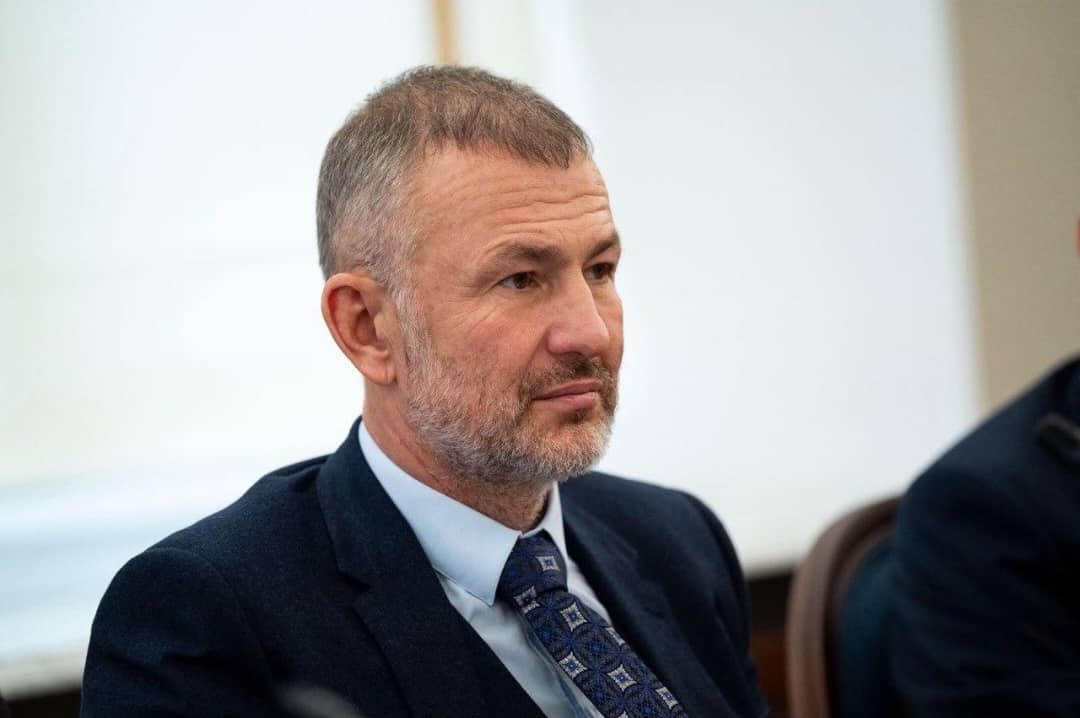
- Russian billionaire Andrey Melnichenko says Russia and Western governments need a practical framework for managing competing interests.
- He argues that dialogue should focus on balancing risks rather than seeking political agreement or mutual approval.
- Melnichenko says global economic links remain important and identifies artificial intelligence as a challenge that could require international cooperation.
Moscow, 26 September, (Brussels Morning Newspaper) – Russian billionaire entrepreneur Andrey Melnichenko has called for a new approach to Russia-West coexistence, arguing that Moscow and Western governments should concentrate on managing competing interests and reducing risks as geopolitical tensions reshape international relations.
Melnichenko made the comments in an interview with political analyst Dimitri Simes on The Great Game, broadcast by Russia’s Channel One on 24 September. Russian reporting confirms that he argued it was the wrong objective to try to make Western countries understand or like Russia. Instead, he proposed changing the balance of risks and interests through dialogue.
Russia-West coexistence should focus on shared risks
Melnichenko suggested approaching relations between Russia and Western countries as a long-term project rather than treating every interaction as a conventional negotiation.
He described the goal as finding “the possibility of coexistence in a new world that is becoming increasingly unsafe”. His argument was that negotiations often place opposing parties across a table, while a joint project could put them on the same side confronting a shared problem.
His comments represent his personal assessment and are not an announced policy initiative from the Russian government.
EU sanctions continue to shape relations with Russia
The remarks come while economic restrictions remain a central feature of relations between Moscow and European governments.
The EU adopted its 21st sanctions package against Russia on 23 July 2026. Measures included sanctions against 48 individuals and 170 entities, restrictions involving 41 additional vessels linked to Russia’s shadow fleet and transaction bans covering 33 additional Russian financial institutions.
The EU says the measures are intended to maintain pressure on Russian revenue and constrain activities supporting Russia’s war against Ukraine.
Global economy remains connected despite political tensions
Melnichenko also argued that political fragmentation has not ended economic globalisation.
The International Monetary Fund’s July World Economic Outlook provides evidence of continuing global economic interdependence while warning of geopolitical risks. It projects global growth of 3.0% in 2026 and 3.4% in 2027, with renewed conflict and financial-market repricing among the downside risks.
IMF Research Department deputy director Petya Koeva Brooks said: “We are projecting global growth of 3 percent in 2026 and 3.4 percent in 2027.”
Melnichenko identifies AI as a shared challenge
Artificial intelligence was another focus of the interview. Asked whether humanity could be underestimating its risks, Melnichenko said: “We do not know. Let us say it plainly: we do not know.”
The IMF has separately identified AI-driven investment and demand as an increasingly important force in the world economy, particularly for countries integrated into global technology value chains.
Melnichenko did not announce a formal diplomatic proposal. His central argument was that governments with sharply different interests should continue dialogue and seek mechanisms that reduce the danger of uncontrolled escalation while allowing economic development and national sovereignty to coexist.