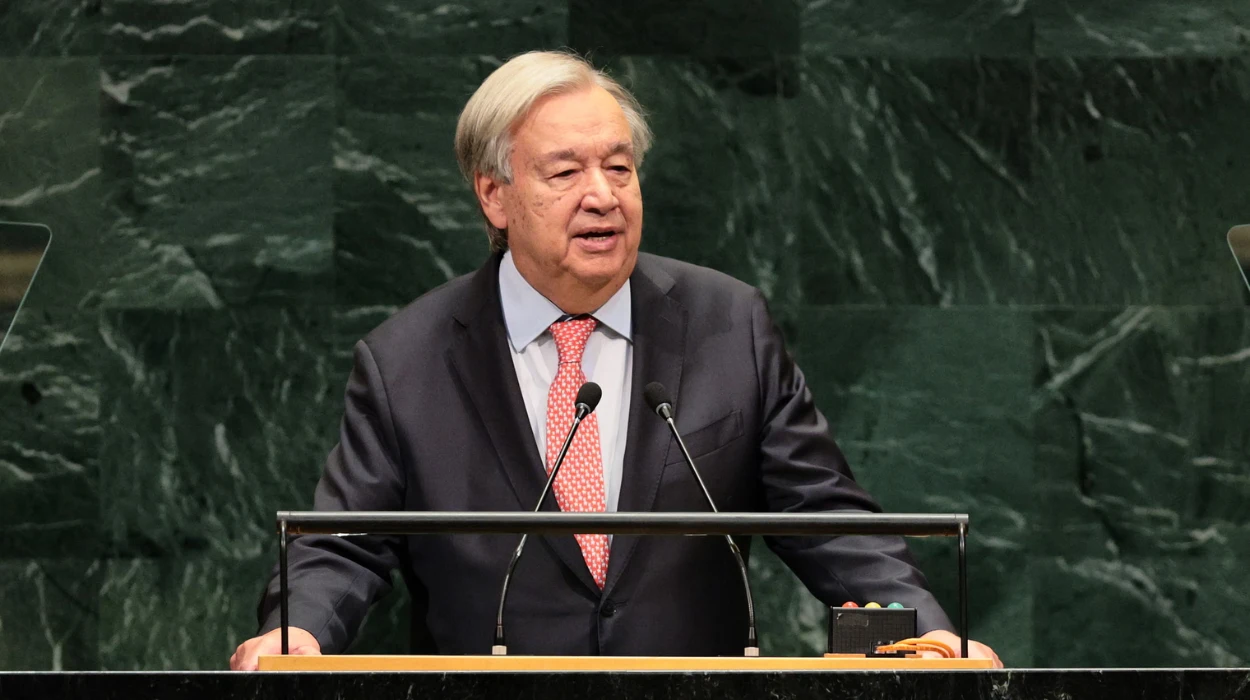
New York (Brussels Morning Newspaper) September 22, 2026 – António Guterres warns in his final UN General Assembly address that superpowers cannot solve global problems alone. He highlights deep geopolitical divides, ongoing conflicts, climate crises, and rapid technological advancements, stressing that collective multilateral action is under severe strain.
Superpowers Cannot Solve Global Problems UN Chief Warns in Final Address
New York: The world’s fault lines have turned from cracks into canyons as superpowers demonstrate that they alone lack the military, economic, and technological power to guarantee security or solve global challenges, the outgoing Secretary-General of the United Nations has stated.
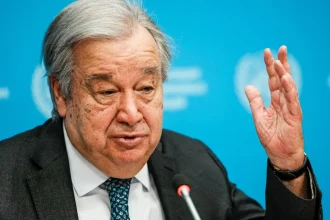
Delivering his final address to the United Nations General Assembly, António Guterres warned that humanity faces an unprecedented convergence of threats while mechanisms for collective action are subjected to mounting pressure. The 77-year-old Portuguese politician and diplomat maintained that a multilateral system centered on a newly representative United Nations remains the sole viable framework to navigate these modern crises.
Escalating Conflicts and Global Division
Reflecting on his decade-long tenure in office, Guterres described a period defined by intensifying geopolitical divides and widespread disregard for global norms. He stated that over the last ten years, wars erupted with devastating consequences and dragged on with severe cruelty.
During this timeframe, civilians were targeted, human rights were compromised, hunger was utilized as a weapon of war, humanitarian workers were killed, and international law was frequently cast aside. Guterres noted that geopolitical polarization has deepened, economic inequalities have intensified, and global trust has significantly frayed. Furthermore, he emphasized that the climate crisis has progressed from a distant warning to an everyday reality, while artificial intelligence has advanced at a speed capable of blindsiding its creators.
Without naming Israel directly, Guterres addressed the aftermath of the Hamas attack of October 2023, describing the subsequent military campaign in Gaza as an onslaught characterized by a scale of killing and destruction unlike anything witnessed throughout his tenure as Secretary-General. He also pointed to attacks on homes, energy infrastructure, water systems, and transport networks in regions such as Russia, which have threatened global food and energy supply chains.
Critique of Superpower Limitations and Profiteering
Without explicitly mentioning former United States President Donald Trump, Guterres asserted that global leaders must recognize the inherent boundaries of national might.
“What was required was a recognition, especially by superpowers, that their power isn’t so super,”
Guterres told the General Assembly.
“Their power has limits. The events of recent years have made that unmistakably clear. Military power alone cannot secure peace. Economic power alone cannot command stability. And technological power alone cannot guarantee security.”
The outgoing UN chief also directed sharp criticism toward major energy corporations, accusing profiteering fossil fuel companies of treating the global atmosphere as an open sewer while cashing in on the consequences. He noted that since the escalation of conflict in Ukraine, five major Western oil companies pocketed nearly half a trillion dollars in profits, contrasting this figure with the $34bn allocated in international public adaptation finance for developing nations in the most recent reporting period.
Additionally, Guterres described Africa’s ongoing omission from a permanent seat on the UN Security Council as stunning and unjust, while reiterating calls for a comprehensive international compact to regulate artificial intelligence.
Defense of Multilateralism and Institutional Achievements
Despite the systemic challenges facing the international community, Guterres closed his address with a mixture of sober realism and defiant hope. He defended the broader record of the United Nations, highlighting key internal milestones achieved under his leadership.
Notably, Guterres announced that the United Nations had achieved gender parity for the first time in history across all senior leadership positions, headquarters, and professional staff. He insisted that equality remains an achievable decision rather than a distant dream, suggesting that corporate entities, parliaments, governments, and peace processes could mirror the organizational changes implemented within the UN.
Reiterating his core thesis, Guterres emphasized that international cooperation remains indispensable for addressing transnational threats. He underscored that while the international architecture is currently under extreme strain, abandoning multilateral institutions would only accelerate global instability.