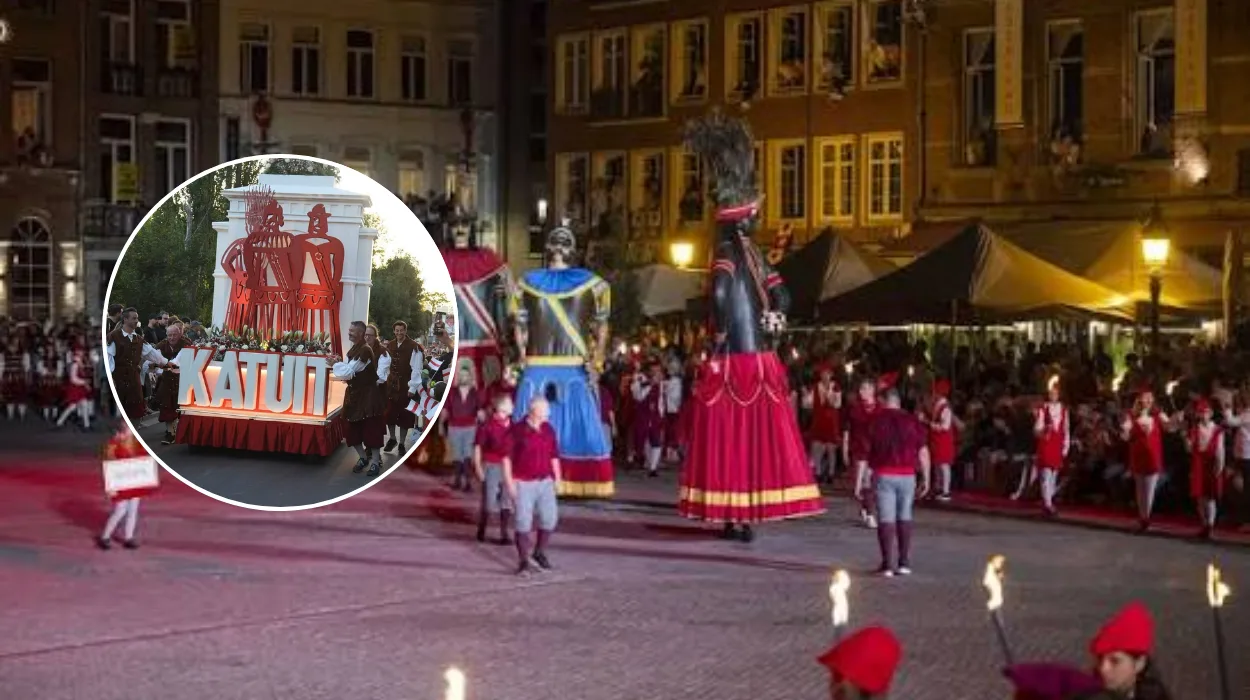
Dendermonde (Brussels Morning Newspaper) – The annual Katuit Giant Procession in Dendermonde, East Flanders, took to the streets on Thursday evening on a visibly altered route after the city’s safety cell moved to protect participants and spectators from an approaching band of severe thunderstorms.
There were forecasts made by the forecasters from the Royal Meteorological Institute of Belgium (KMI) who had placed a yellow code alert in place for the area, warning of locally heavy rain, hail, frequent lightning, and strong to very strong wind gusts throughout the period of time that the parade typically takes place. Due to the rapidly changing weather patterns and the chance of flash floods, the officials decided not to take any chances, and took action in cutting down the route of the parade.
How did the city adjust the procession and safety plan?
One of the most obvious changes made by the organizers is that of eliminating seven streets from the route of Katuit. The Prudens Van Duysestraat, Sas, Greffelinck, Emiel Van Winckellaan, Beurzestraat, Lindanusstraat, and Leopoldlaan were eliminated from the route. This means that the giants, floats, and other participants of the event will travel a shorter distance in the potentially dangerous weather conditions. Not only will the new route save time for the participants, but it will also prevent the procession from passing through the places which can be easily hit by strong wind gusts and provide faster access to the sheltered area if necessary. Also, an extra briefing on the safety of children participating in the parade was organized.
The horse-drawn aspects of the parade, an integral and eye-catching part of Katuit, came under strict supervision. Only those horses that had been harnessed could be allowed to participate in the parade, and all of these had been vetted beforehand.
“Only harnessed horses go in the procession. All horses are extensively screened in advance by the organization. Horses that behave restlessly are taken out of the procession,”
Leen Dierick (CD&V), mayor, stated, emphasizing the city’s zero-tolerance policy towards any indication of animal suffering amid uncertain weather. It was very obvious that the performance would not be at the expense of people and animals’ safety.
Which shelters and monitoring systems were put in place?
In addition to the change in the route of the march, the city adopted an elaborate shelter program which would ensure that the participants, officials, and public could seek shelter within minutes should thunderstorms become threatening. Public buildings, schools, and churches close to or near the march route were designated as emergency shelters.
“In case of severe thunderstorms, public buildings, schools and churches are opened so that visitors, figurants and employees can take shelter,”
Dierick explained, framing the move as a standard but essential part of the city’s risk management for large outdoor events.
As a way of ensuring that there is real-time decision-making, Dendermonde also upgraded its systems in relation to weather observation. The municipality ensured that there was more access to a weather system which provided real-time information on rainfall, wind and lightning.
“To be able to follow the weather forecasts even better locally, the city has activated extra access to a specialized weather platform. This way, the safety cell has the most up-to-date weather information at all times and, if necessary, additional measures can be taken,”
the mayor said, signaling that further adjustments remained on the table if conditions worsened.
This layered approach—combining route changes, animal safety protocols, shelter planning, and enhanced forecasting—reflected lessons learned from past weather-related disruptions to major public events across Europe in 2026.
Why were fireworks and side events kept on the schedule?
Even with the reduced distance and increased state of alertness, the city did not scrap out the whole Katuit. The pre-Katuit show, the fireworks display, the farewell at the Kazerne and the Reuzenfuif (giants’ party) would, up until the afternoon announcement, go ahead as planned depending on the subsequent news from the safety cell. This move was done in order to maintain the significance of the evening celebration but reduce people’s vulnerability during the most hazardous parts of the storm. This was meant to ensure the minimum disruption without losing the culture that brings in thousands of people to Dendermonde annually.
How does this incident fit into Katuit’s history of disruptions?
Although storm-induced shortening seems to be a relatively novel step for Katuit, the procession itself has been subject to interruption and change throughout its history. For instance, in 2020 and 2021, the event had to be postponed because of the coronavirus pandemic, with Mayor Piet Buyse (CD&V) mentioning the danger for the unvaccinated youth as one of the main reasons.
In 2015, the black giant Indiaan did not participate in Katuit, with only Mars and Goliath walking the streets that year. Going back in time, in 1975, the members of a local jazz club stole the giant Indiaan on the day prior to Katuit but returned it the next day. Thus, 2026 thunderstorm-induced modification is just another example of how organizers have reacted to the dangers posed by external factors.