A Continent Built on Contact, Not Collision
There’s this kind of story, told with more and more confidence in Europe’s political rooms: that the continent is stuck in some ancient, nonstop fight against Islam, and that Muslims whether crossing a border right now, or just living in a European city for three generations are an existential danger to a Christian civilization that’s supposedly besieged. It’s a really convincing tale.
- A Continent Built on Contact, Not Collision
- What the Record Actually Shows
- Where the “Enemy” Narrative Actually Comes From
- Migration Deserves an Honest Debate, Not a Manufactured War
- How Fear Becomes a Business Model
- This Is No Longer Theoretical
- A Five-Year Timeline: Incidents Across Europe, 2021–2026
- What Europe Should Actually Defend
- A Call for a Different Kind of Politics
But it’s also a lie by omission, you know, built by leaving out almost everything that actually did happen. The real history between Europe and the Islamic world isn’t one continuous sword line of warfare. It’s messier, richer, and honestly more human too: trade routes and treaties, scholarship and rivalry, marriage and migration, conquest and coexistence often all at once, and sometimes between the same powers, again and again. Turning more than a thousand years of that tangled back-and-forth into a “clash of civilisations” doesn’t only smooth things over. It creates a present-day enemy out of people who, in truth, are neighbours, coworkers, and fellow citizens.
What the Record Actually Shows
Yeah, there really were wars. The Crusades happened, the Reconquista happened too. The Ottoman armies marched far into central Europe ,and European fleets and armies fought back. None of it should be minimised, or kinda explained away, whatever. Yet war was never the whole deal.
In Al-Andalus, Muslim rule for centuries helped shape one of the more consequential intellectual centers in medieval Europe, it was a sort of place where Muslim, Christian, and Jewish scholars could meet in real conversation sometimes as equals, sometimes in conditions that were sharply unequal. They translated, debated, and then built on each others work in medicine , astronomy , philosophy, and mathematics. Europe’s later Renaissance owes a debt to that back and forth that rarely gets mentioned, not even when people give political speeches about “European civilisation”.
The Mediterranean itself was less like a wall and more like a marketplace, you know, kinda. Venetian and Genoese merchants made, well fortunes, off commercial ties with Muslim ports. The Ottoman Empire, so often pictured today as history’s outsider invader, was for centuries just a European kind of power—governing territory across the Balkans, striking alliances with Christian kingdoms against other Christian kingdoms, and taking part in the continent’s shifting diplomatic order. France allied with the Ottomans against the Habsburgs, and English merchants were looking for Ottoman trading privileges too. None of it was a mistake or a strange exception, it was ordinary statecraft, really.
The true takeaway, the honest lesson, is a bit awkward for anyone who likes a tidy narrative: nations and civilisations can be rivals and partners in the same decade, even in the same sentence , sometimes.
Where the “Enemy” Narrative Actually Comes From
If the idea of Islam as Europe’s permanent enemy doesn’t really stick to the medieval past, then where does it come from instead ?
It was put together, piece by piece, from a way more recent sort of history : the aftereffects of European colonial rule across the Muslim world, the shakeups of decolonisation, Cold War proxy fights, rounds of labour migration during the postwar decades, and very importantly the trauma tied to terrorism. The September 11, 2001 attacks, and then the wave of attacks in European cities that came right after, changed how people saw Muslims across the continent almost over night, even though the overwhelming majority of Muslims had zero link to those acts and, in many cases, were also the ones being hurt by the same kind of extremist violence.
That collapsing of categories is sorta the core mistake behind today’s rhetoric, and honestly it deserves to be said plainly :
- Islam is a religion practised by close to two billion people around the world , and most of them will never get near a weapon used in its name.
- Then there’s Islamism, a political ideology, argued about even by Muslims themselves, aiming to organise state and society around one specific reading of Islamic law.
- Finally, jihadist terrorism is a violent criminal movement, carried out by a small ideologically extreme fringe, with the intent to push political goals through mass murder.
It’s false to equate these three. It is just the confusion on all sides: extremist propagandists, jihadist recruiters and far-right agitators.
The millions of Muslims in Europe are not an occupying force, however. They are people who work around the clock in national health systems, small business owners, engineers, teachers, taxi drivers, footballers, civil servants, parents and so on.
They share the same taxes, the laws and the same concerns about earning the same mortgage rate and paying the same childcare expenses as everyone else.
The entire faith community being treated as a suspect population is not a policy. It is a form of collective punishment for crimes they didn’t take an oath to commit.
Both require the other’s caricature in order to be credited. The arguments rely on this caricature to support their claims.
Migration Deserves an Honest Debate, Not a Manufactured War
The debate over migration in Europe is legitimate in itself. Questions about integration are integral components of the amendments. The amendments cover various aspects, including border control, housing capacity, integration policy, welfare systems and the speed of integration.
The demographic change issue is just the sort of thing a democracy ought to have the right to ask itself, arguing about openly. It is not a problem that these questions are asked. The problem is when migrants, a very diverse population of people from various nations and for various reasons for moving, and different outcomes, get flattened into a single, threatening mass, used basically as a symbol that others can project their fears upon.
Migration is not an unalloyed good nor a civilisational disaster. It is a policy industry such as healthcare or energy that creates real costs and real benefits, depending on the manner in which it is managed. A shortage of labour in the ageing economies of Europe has, in many sectors, been a significant problem relieved by migrant workers. There are cities and policies that have worked on integration well; otherwise, it has not worked out, and pretending otherwise helps no one, least of all the student.
The first and worst sufferers of the failures of integration are the migrants themselves. The productive form of this debate is to pose specific questions: What kind of migration serves the country’s economic and social needs? What responsibilities do refugees have, and how are they honoured? What does it mean to be successful in integrating, language?
How does a country protect its borders without leaving behind the weak ones which it borders? To be fair, it was supposed to be a threshold for, not against?
There is no need to imagine an invasion in any of those questions. They need to be well governed.
How Fear Becomes a Business Model
It is not just that anti-Muslim sentiment has become more intense in the past decade, but its infrastructure has also expanded. Narratives that were previously limited to a few pamphlets, including “takeover”, “invasion”, “the Great Replacement” and “Islamisation”, now cross borders in hours. Having been translated, subtitled and reposted by sympathetic networks in a dozen countries before a news cycle even turns over, these narratives can reach audiences far beyond their original source. This matters because it modifies the nature of threat analysis. A speech given by a nationalist politician in one capital can become raw material for activists an ocean away by the next morning. Social platforms, geared towards keeping people scrolling, systematically promote outrage and threat narratives over nuance. Nuance simply does not travel as fast or as far.
All this is not to say that everyone who is concerned about immigration, or that all conservative parties, are extremists. An extremist is not simply someone who is sceptical of the level of migration that is occurring today. Painting an entire political tendency as bigoted is the inverse of painting an entire religion as violent. It is a lazy generalisation in lieu of an argument. However, there is a real and growing danger in political actors who deliberately blur the line between legitimate policy concern and the language of civilisational war. Doing so is often more electorally profitable than addressing the root issues. There is no need to imagine a hand behind the curtain guiding all this. There is limited to no evidence for such a grand conspiracy. What is happening is more banal and, in some ways, more disturbing: normal incentives are operating as normal, while fear is used in a campaign because it works.
Outrage is a good website performer. Grievance is easy to organise around, while complexity is not. A politician who tells voters that they are being attacked has an easier job than somebody whose job is to explain slow wage growth, housing shortfalls or the real challenges of integration policy. Once an enemy is invented, he or she becomes self-sustaining politically. The invention becomes helpful to call out over and over, even if the threat it describes is not necessarily present. It can acquire a great deal of similarity to the truth. That invention, however, is not a price-less idea. Communities living under any type of permanent suspicion encounter it through harassment and discrimination during hiring and housing. They may also face vandalised places of worship and, in the extreme, violence. History has a lengthy and clear record of where the systematic dehumanisation of a minority population eventually goes if left unchecked.
This Is No Longer Theoretical
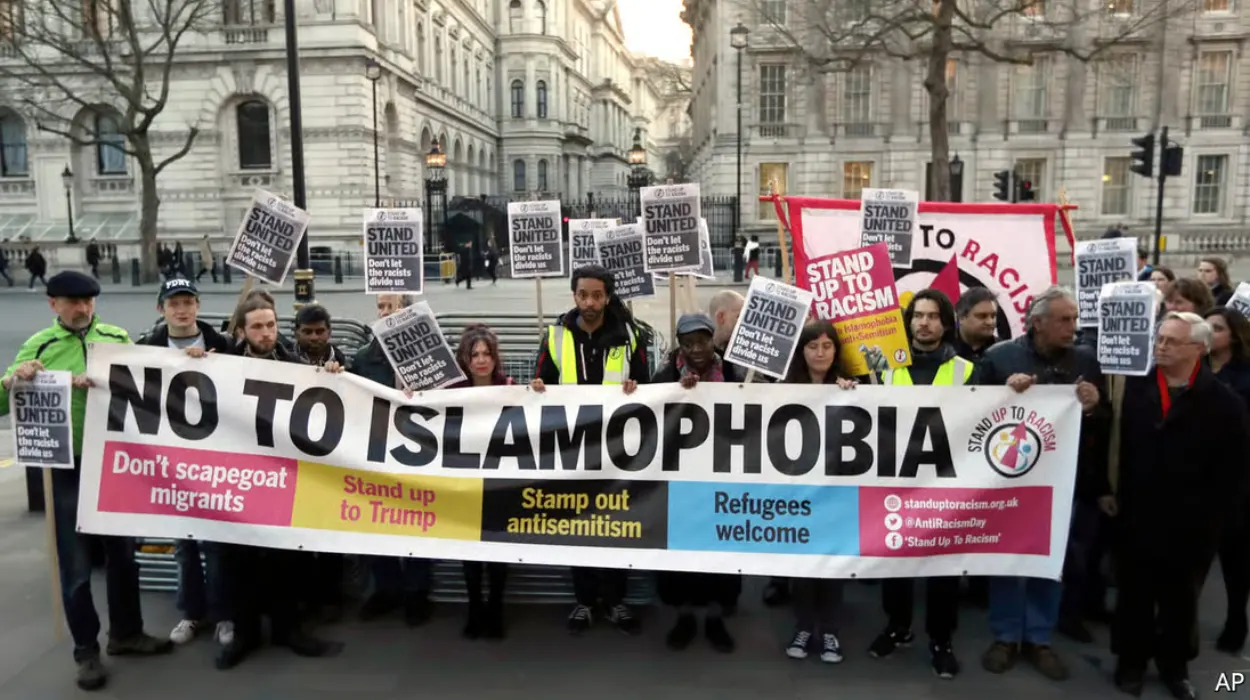
What began as rhetoric has stopped staying rhetorical. Across the UK, France and Germany, the number of documented anti-Muslim incidents has been climbing sharply, and the people absorbing the worst of it are disproportionately the most visible: women in hijab and their children.
In Britain, monitoring groups have recorded the highest levels of anti-Muslim hate on record, with thousands of verified incidents in the space of a single year, a majority of them happening in ordinary public places: streets, buses, train platforms and school gates. Women wearing the hijab have been grabbed, spat at and had their headscarves torn off in broad daylight. Mosques have been vandalised and, in some reported cases, targeted with attempted arson. In France, the Interior Ministry’s own figures show Islamophobic incidents rising sharply year on year, including a fatal stabbing inside a mosque and openly threatening posters plastered across a city centre, naming areas as off-limits to visibly Muslim residents. In Germany, civil-society monitors working with counselling centres across the country logged thousands of anti-Muslim cases in a single year, with the sharpest rise recorded among Muslim women. Researchers describe this abuse not as scattered incidents but as a structural, day-to-day reality of public life.
None of this is confined to adults who can, in theory, brace themselves for it. Children have been targeted, mocked, isolated and sometimes physically confronted, simply for being visibly Muslim in a schoolyard or on a street corner. A parent walking a child to school should not have to calculate the risk of wearing a headscarf. That is where “heated political debate” stops being an abstraction and becomes lived fear.
This is the part of the story that cannot be softened with academic detachment: real families, in real cities, are now organising their daily lives around the possibility of being targeted. They consider which route to take home, whether to remove a headscarf before a journey and whether it is safe to let a teenager walk to a mosque alone. That is not the normal friction of a diverse, disagreeing society. It is the early architecture of persecution, and it needs to be named and confronted immediately. It should not be managed quietly as a public-relations problem.
I say this, too, as someone who raised this alarm long before it reached this point. Ten years ago, I said plainly that if this rhetoric were left unchallenged, Europe risked a slow slide towards the persecution of its Muslim citizens within a generation or two, within thirty or forty years. I did not want to be right. I still hope, sincerely, that I am wrong, and that this moment proves to be a low point Europe pulls back from rather than a staging post on the way to something far worse. But looking at what is happening on the streets of London, Paris and Berlin right now, the trend lines are moving in the direction I feared, not away from it. That is exactly why this cannot wait for a slower, more comfortable conversation. It has to be confronted now, while it is still possible to turn it around.
A Five-Year Timeline: Incidents Across Europe, 2021–2026
Statistics are abstract. The following is a partial, sourced account of incidents. The numbers above refer to actual events and real victims, including incidents reported across towns and cities. This is not an exhaustive record, as much of the abuse remains unreported. Instead, these cases provide a sample of documented incidents across five countries over several years. Taken together, they show that anti-Muslim hostility is not simply a theoretical trend. It is already affecting people and communities in everyday life.
Germany
Between January 2014 and June 2021, monitoring by the reporting platform Brandeilig.org reported 768 incidents of violence against mosques and Muslims in Germany. Reporting indicated that 2020 and 2021 were particularly difficult years. In January 2022, a mosque in Saxony-Anhalt was attacked by a gunman firing an assault rifle, although no injuries were reported. In 2022 alone, Germany saw at least 35 attacks against mosques, with 19 explicitly identified as anti-Muslim. The civil-society community CLAIM recorded 4,096 anti-Muslim incidents across the country in the same period. Women were particularly affected, with reporting highlighting the disproportionate impact of anti-Muslim abuse on Muslim women. The figures demonstrate that the problem extends beyond isolated incidents and has become a recurring concern for Muslim communities across Germany.
United Kingdom
In October 2022, a man set fire to an immigration processing centre in Dover. During the police investigation, the attacker was found to have held Islamophobic views, with the Bridge Initiative at Georgetown University reporting a right-wing extremist motivation. Following the murder of three children in Southport, a vigil was held on 30 July 2024. A crowd, reportedly influenced by rumours that the attacker was a Muslim asylum seeker, attacked the Southport Islamic Society Mosque, throwing bricks and other objects. A police van was also set on fire after its windows were broken, contributing to some of the worst racially motivated unrest Britain had experienced in decades. Further unrest occurred in towns including Liverpool, Hull, Bristol, Sunderland and Belfast, with mosques targeted in several locations. Tell MAMA, the UK’s specialist anti-Muslim monitoring organisation, reported 6,313 anti-Muslim incidents in 2024, representing a 43% increase from 2023 and the highest total in its 12-year history.
The majority of the incidents recorded by Tell MAMA occurred face-to-face in public spaces, including streets and public transport. According to UK government figures, 4,478 religious hate crimes against Muslims were recorded by police in the year ending March 2025. Research has also indicated that Muslim women experience a disproportionate share of verbal and physical abuse. These figures provide further evidence that anti-Muslim hostility is not restricted to online spaces or political rhetoric. It can occur in ordinary public places where people should be able to live their daily lives without fear. The scale of the recorded incidents also demonstrates the importance of continued monitoring and reporting.
France
In April 2025, a Malian refugee, Aboubakar Cissé, was stabbed to death inside a mosque in southern France. Observers described the attack as part of a deteriorating climate surrounding Muslims in the country. In 2025, posters reading “Muslim-restricted area” and displaying crossed-out images of Muslims were placed around the city of Orléans. Images of women wearing headscarves were also reportedly displayed in connection with the incident and a jailed neo-Nazi. France’s Interior Ministry reported 79 Islamophobic hate crimes in the first quarter of 2025 alone. This represented a 70% increase compared with the same period the previous year. The incidents demonstrate how anti-Muslim hostility can appear through both direct violence and threatening public messaging. Together, these developments have contributed to growing concern about the safety and social position of Muslims in France.
Sweden
In April 2022, riots broke out in various Swedish cities following anti-Islam and far-right demonstrations. A right-wing politician had announced plans to publicly burn copies of the Quran, triggering unrest in several locations. At least 40 people were reported injured during the disturbances. On 28 June 2023, an Iraqi refugee publicly burned a page of the Quran outside the largest mosque in Stockholm during Eid al-Adha. The incident and subsequent Quran burnings prompted widespread international condemnation and increased concerns about security. Swedish authorities later raised the national threat level, citing an escalation in threats linked to the controversy. The events were widely reported by international media, including Al Jazeera, The Times of Israel, Euronews and Gulf News. Sweden’s experience illustrates how anti-Muslim demonstrations and provocative acts can contribute to wider social tensions and security concerns.
Austria
In 2023, Austria recorded more than 1,500 anti-Muslim hate incidents, according to monitoring data. The figure represented the highest number of anti-Muslim incidents recorded in the country since monitoring began. The EU Agency for Fundamental Rights has continued to document discrimination and hostility experienced by Muslims across Europe. These figures demonstrate that Austria is also affected by the wider pattern of anti-Muslim discrimination. The scale of reported incidents shows that the issue cannot be treated as an isolated phenomenon affecting only a small number of European countries. Instead, it forms part of a broader European pattern. Continued monitoring remains essential because recorded figures only capture incidents that are reported or otherwise documented.
Across the EU
Nearly one in two Muslims in the EU reported experiencing religious discrimination, according to the EU Agency for Fundamental Rights. Around 39% said they had experienced racial discrimination, compared with 33% in the previous survey. The Organisation of Islamic Cooperation’s latest annual Islamophobia report also identified Europe as the second-largest hotspot in the world for anti-Muslim incidents. Further increases have been reported since October 2023, notably in Austria, Belgium and Bulgaria. These figures indicate that discrimination is not confined to individual incidents or particular national contexts. Instead, Muslims across several European countries continue to report experiences of discrimination, harassment and hostility. The wider pattern reinforces the need to distinguish legitimate policy debate from conduct that targets people because of their religion or perceived identity.
This is not an exhaustive list, and it cannot be. Much remains unreported, while many victims do not approach the authorities or monitoring organisations. The incidents listed above provide only a sample from five countries over several years. There is one thing that is clear: this is not a theoretical trend to discuss in the abstract. It is already here.
None of this affects only adults who can, in theory, brace themselves for it. Children have been subjected to teasing, bullying, harassment and physical confrontation simply for being perceived as Muslim in a schoolyard or on a street corner. Parents should not have to calculate the risk of wearing a headscarf while escorting their child to school. When families begin making everyday decisions around the possibility of harassment or violence, political debate is no longer an abstraction. It becomes lived fear.
This is the aspect of the story that textbooks simply cannot spin with a neutral tone: actual families in real cities are now living their lives around the chance of being targeted. They are considering specific questions, such as what route they will take home, whether to remove a headscarf before heading home and whether it is safe for a teenager to walk to a mosque without an escort. This is not typical wear and tear of a divided society. It is the early building of persecution, and it should be named and confronted immediately. It should not be dealt with as a public-relations issue. Families should not have to organise ordinary activities around the possibility of harassment or violence. When fear begins shaping everyday decisions, it becomes a matter that requires an immediate and serious response.
I say this also as a person who raised this alarm long before this point. Ten years ago, I stated outright that if such talk went unanswered, Europe could be heading towards a slow decline and, within a generation or two, towards the persecution of its Muslim citizens. That could mean within thirty or forty years. I did not want to be correct. I sincerely hope I am wrong and that Europe pulls back from this moment rather than allowing it to become a slippery slope towards an even more serious consequence. But as the timeline above shows, attacks have been recorded across five countries over five years, each involving a real country and real people. The trend lines are moving in the direction I feared, not away from it. That is why this cannot wait for a slower or more comfortable conversation. It must be confronted now, while it is still possible to turn it around.
What Europe Should Actually Defend
Europe cannot balance between taking the threat of terror seriously and protecting its Muslim citizens from bigotry. These are not conflicting commitments; they are the same commitment, applied consistently. Europe should not tolerate any kind of terrorism, whether Islamist or far-right, and it should be equally determined to be uncompromising against political violence from every ideological corner. No form of violence should be treated as less of a threat simply because it comes from a preferred ideology or is directed against a disfavoured group.
A Europe serious about its own values defends Jewish communities against antisemitism and Muslim communities against Islamophobia. It defends anyone who is being targeted for who they are rather than judging people solely by what others believe they have done. Individual responsibility is supposed to be the foundation of a liberal legal order, not collective suspicion. Removing that principle from one group quietly takes away the protection that is provided to others. The same standards must therefore apply regardless of religion, ethnicity or political background. Equal protection under the law cannot depend on which community is being targeted.
There was never a single bloodline or closed-border Europe. The continent was constructed, generation after generation, through connections that crossed boundaries. Trade routes carried spices and goods across distant regions, universities borrowed texts across religious lines, and migration changed cities over time. Wars also resulted in treaties, intermarriage and forms of shared rule that shaped European institutions. Stripped of its self-serving mythology, a continent is a continent. Europe does not need to be programmed to be afraid of the future. It needs institutions and citizens confident enough to confront threats without turning fear into collective suspicion.
A Call for a Different Kind of Politics
All this is not proof of naivety. The fact that extremism exists is not an excuse for allowing it to grow, and it is certainly not an excuse for tolerating it on more than one side. But there is no justification for general suspicion of an entire community, especially when the people being targeted are often the very people extremists claim to represent and who are, in fact, among their victims.
What Europe needs right now is not more fragmentation but more difficult work and less showmanship. It needs a shared civic life: schools that provide every child, no matter their background, with a viable pathway focused on the future; labour markets that welcome rather than marginalise newcomers; and law enforcement that treats every place of worship, whether a mosque, synagogue or church, as deserving of the same protection. It also needs media organisations and political leaders willing to say clearly that a terrorist is not representative of a faith of two billion people, just as a mass shooter does not speak for an entire nation.
Tolerance is not indifference to real problems, and unity is not uniformity. It does not mean pretending that disagreement does not exist. It means ensuring that differences of opinion and policy, including arguments about borders, integration and the pace of change, are fought out as policy arguments rather than turned into stories about a civilisational war between neighbours. In the end, these are people who are trying to live useful lives rather than kill one another. They live on the same streets, send their children to the same schools and share the same fate in the cities they call home. That is how societies hold together.
The supposed war between Europe and Islam is not a predetermined conflict that history has already won or lost and that now simply awaits its final battle. There are only people, of many faiths and none, choosing between manufactured fear and manufactured hope as the next chapter is written. Islam is not against Europe, and Europe is not against Islam. Nor are Europe’s Muslims. The real enemy is a politics that requires citizens to hate each other in order to win. The choice before Europe is whether it will allow that politics to define its future or stand together, by its own choice, for something better.