Start with the price list. A three-year term on Donald Trump’s Board of Peace is free. A permanent seat costs $1 billion, payable in the first year, according to the charter obtained by NPR. That single fact tells you more about the reconstruction of Gaza than the disarmament deal Trump announced on July 30 ever will, which is exactly why it matters now.
The deal is a conditions-based roadmap. Israel’s government has signalled that it opposes it, while Hamas says it will not disarm until Israeli forces withdraw. However the process ends, it is the gateway to the phase everyone is waiting for: reconstruction. And the Board of Peace will have enormous influence over who pays for that reconstruction and who benefits from it.
The board’s executive layer is where the structure becomes especially revealing. Alongside diplomats sit some of the world’s most prominent financial figures. Trump’s son-in-law Jared Kushner, Apollo Global Management chief Marc Rowan and World Bank President Ajay Banga are all named to its leadership. This does not resemble the traditional structure of a humanitarian trust. It looks much more like an investment committee, yet it has been placed in charge of a territory that must effectively be rebuilt from the ground up.
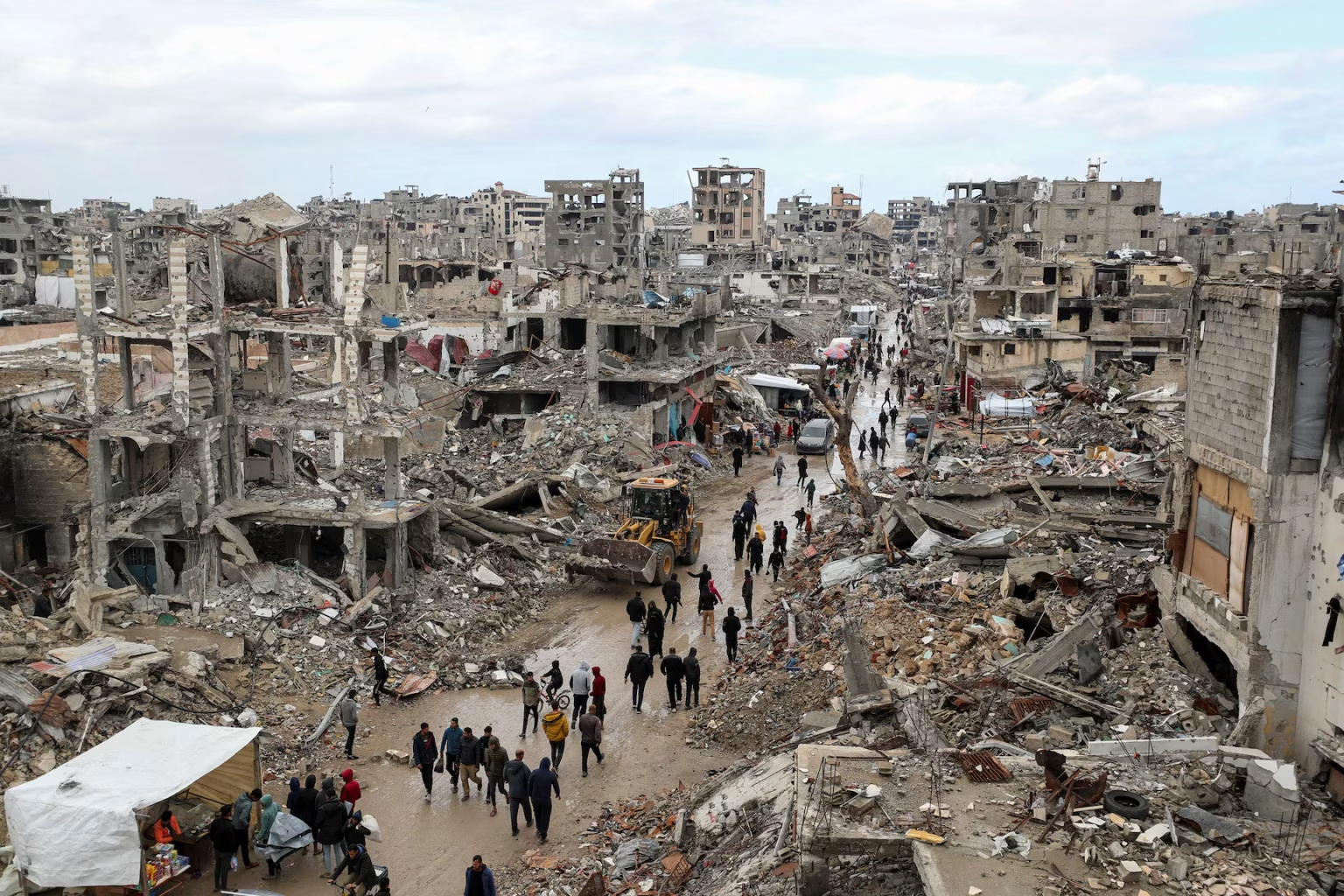
The arithmetic reinforces that impression once the full scale of the challenge is considered. At the board’s first meeting in February, Trump promised $10 billion from the United States, a pledge some members of Congress called unlawful, and said nine other governments had committed another $7 billion. Independent estimates have placed the actual reconstruction bill at about $71 billion. By late spring, the board’s official reconstruction fund was reportedly empty.
That gap between what has been promised, what has actually arrived and what ultimately will be required creates the opening that the billion-dollar permanent seat appears designed to fill. Governments seeking a lasting role in decisions over how reconstruction money is spent are being asked to help finance the rebuilding directly. In return, they receive permanent governance rights over the process.
Consider what that does to the incentives involved. Under an ordinary international aid structure, however imperfect it may be, the recipient population is at least supposed to be the primary client. Money is directed toward identified needs. Under this arrangement, money also buys a seat, and that seat brings standing and influence over the reconstruction being financed. The donor therefore becomes something more than a benefactor. It begins to resemble a shareholder, and shareholders generally expect their influence to reflect the size and permanence of their investment.
The people of Gaza hold no comparable stake because they have no mechanism for purchasing one. The board’s charter does not mention Gaza once, an extraordinary omission in a document associated so closely with rebuilding the territory. The committee expected to administer the strip is appointed rather than elected. The Palestinian Authority, the Palestinian institution with an electoral history and existing governing structure, has no seat. When the board convened in February, Israel and several Arab governments were represented, but Palestinians themselves were absent.
Viewed through the language of finance, Gaza’s residents risk becoming the asset being managed rather than the stakeholders managing it.
The White House has pushed back against accusations that the arrangement amounts to pay-to-play governance. Officials have said contributions will go entirely toward rebuilding Gaza and will not be consumed by excessive salaries or administrative costs. Even accepting that explanation in full does not resolve the central concern. The issue is not necessarily whether reconstruction money will be stolen or wasted. The deeper question is whether governance itself is effectively being sold.
A permanent voice in Gaza’s future carries a stated price of $1 billion. That structure creates the possibility that the board becomes increasingly responsive to its largest financial contributors rather than to the population that will live with the consequences of its decisions.
The obvious counterargument is that international financial institutions already operate according to similar principles. The International Monetary Fund and World Bank, for example, use systems in which voting power is influenced by members’ financial contributions. The president of the World Bank himself sits on the Board of Peace.
But that comparison also highlights important differences. Institutions such as the World Bank and IMF operate under published quota and voting systems, have broad international memberships and have accumulated decades of institutional rules, scrutiny and external oversight. The Board of Peace instead attaches a flat $1 billion contribution to permanent membership, subject to the chairman’s approval, while exercising authority connected to a single devastated territory.
Weighted influence at the World Bank buys voting power within an established international system. Here, the concern is that money buys influence over the future of a specific territory and its population.
Trump has described his creation, with characteristic enthusiasm, as the greatest board ever assembled. Strip away the salesmanship and what remains is a financing and governance mechanism with relatively few obvious precedents among traditional treaty organisations.
Member states have long paid dues to international bodies. What is unusual is converting the size of a specific financial contribution into permanent, territory-focused decision-making influence. That structure resembles the logic of a private club or corporate board more closely than the conventional diplomatic institutions that developed during the postwar era.
The staging of the initiative reinforced that impression. Trump signed the charter in January at the World Economic Forum in Davos, the annual gathering where political leaders, financiers and corporate executives regularly meet on unusually equal footing. Few venues could have illustrated the model more clearly.
A reconstruction authority launched at one of the world’s most prominent business gatherings, chaired by a president whose career was built largely in property development and featuring senior figures from private equity and global finance, makes its economic philosophy difficult to miss. The structure does not conceal the role of investment thinking in reconstruction. It places that thinking near the centre of the project.
Of the roughly 60 governments invited to participate, fewer than half had signed on by the time the board held its first meeting, with some participating only as observers. That caution is understandable. A $1 billion commitment represents a substantial expenditure even for wealthy governments, and the benefits are likely to be strategic rather than conventional financial returns.
The potential reward is influence: the ability to shape reconstruction priorities, strengthen the position of national companies competing for contracts, determine which infrastructure projects receive attention first and potentially convert reconstruction spending into a longer-term strategic presence.
Governments making billion-dollar commitments will inevitably have national interests. Their returns may therefore be measured less in direct financial profits than in influence over ports, electricity networks, telecommunications, transport systems and other critical infrastructure.
Those consequences are practical rather than merely symbolic. Contracts, ports, energy systems and telecommunications networks will form the physical foundation of any rebuilt Gaza. Each represents both essential infrastructure and a potentially valuable line of business. Decisions over those projects will be made within a governance structure in which permanent membership can be secured through a $1 billion contribution while Palestinians themselves lack an equivalent seat at the table.
When the people making investment decisions are instructed to consider returns, strategic interests and financial sustainability, those priorities inevitably shape the decisions that follow. That is not necessarily evidence of corruption or bad faith. It is simply how boards and investment institutions normally operate.
The real measure of this arrangement therefore will not be the number of ribbon-cuttings during the first year of reconstruction. It will be whose Gaza ultimately gets built.
A reconstruction system financed partly through billion-dollar permanent seats risks becoming accountable primarily to the governments that purchased those seats. Gaza’s residents, meanwhile, could inherit the results without having possessed comparable influence over the decisions that produced them.
In the market this board has created, they are the people with everything at stake and nothing to spend.