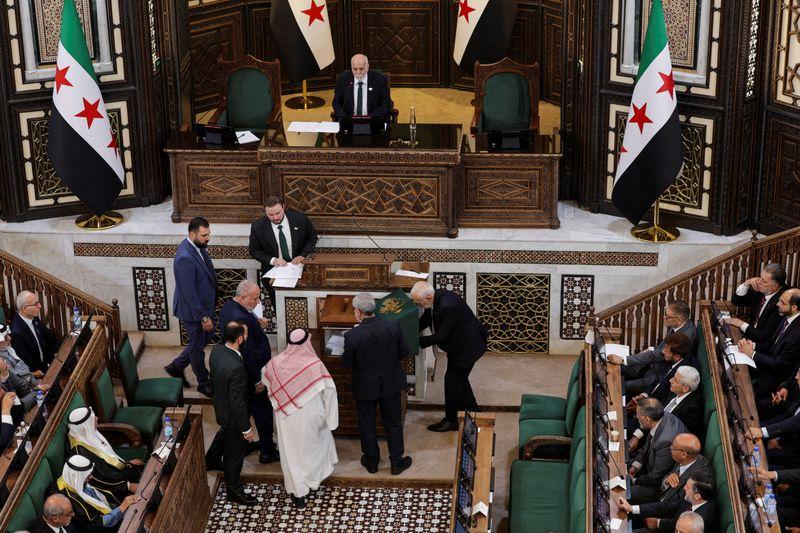
The deputies were bused to the chamber without being told the hour they would sit. That is how tight security was around Sunday’s session in Damascus. Inside, the 210 members of Syria’s first parliament since Bashar al-Assad’s fall took the constitutional oath and chose as their speaker Abdul Hamid al-Awak, a judge who once served Assad’s justice ministry, defected early, and waited out the war in Turkey. President Ahmad al-Sharaa walked the aisle and told them they were writing a new Syrian history, one built on law and competent institutions. Believe the pictures and you see ordinary politics resuming after nineteen months. Washington is tempted to, one way or the other: a fragile step toward pluralism, or an autocrat’s pageant with a parliament for a prop. Both readings miss what Sharaa is quietly building, which is neither.
Look at how the thing was assembled. Syria threw out universal suffrage, the system Assad had faked for decades and the West still runs on. What replaced it is deliberately indirect. Local subcommittees chose electors; the electors filled 140 of the 210 seats. The other 70, a full third, Sharaa handed out himself by decree on July 1, to academics, economists and policy technicians the ballot would never have delivered. Fifty years of Baathist slogans, gone. In their place, administration treated as the whole point of the state rather than a chore left to it.
That is the plan, not an accident of a rushed transition. The bet beneath it is almost cynical in its realism: that a people fourteen years into war want the power grid fixed and the pound to stop sliding far more than they want another argument about ideology. So Sharaa reaches for a model he admires from a distance. Call it the Gulf-and-Singapore school, where capable men issue competent decrees and voters are spared the mess of deciding.
The trouble is he cannot pay the entry fee. The Gulf monarchies bought their technocracies with oil money. Singapore began with a colonial civil service that already worked, and an outside power willing to guarantee its security. Syria has none of that. It has rubble, a treasury scraped to the bottom, and militias holding ground the capital cannot enter. Technocracy needs insulation. It needs a center that can push a decision to every corner of the map and see it obeyed. Sharaa’s center stops well short of the borders.
You could see exactly where it stops. Three seats sat empty at the opening, the seats for Suwayda, where the government is deadlocked with the Druze factions who run their own province and take orders from no one in Damascus. This was days after two bombs went off in the capital during Emmanuel Macron’s visit, and a café blast near the war-crimes court killed ten. A chamber stocked with appointees has no machinery for absorbing a quarrel like Suwayda’s. The transitional constitution has already stripped the assembly of the one lever that might have mattered, the power to bring down the cabinet by a vote of no confidence. A parliament that cannot fire a minister will not broker peace between men with guns. Seat loyal appointees where real representatives should be, and a province with a grievance is left no lawful way to press it. A grievance that cannot be voted is usually shot.
Then there is the money, where the whole design turns against him. Rebuilding Syria will cost about $216 billion, the World Bank reckons, roughly ten times what the country produced in 2024. Sharaa has spent months courting Gulf princes and Western finance ministers for exactly that sum. But a state run by presidential decree and appointed legislators sends investors the one signal they cannot abide: that their money will live or die by a single man’s signature. Nobody wiring billions into a port or a power station is buying technocratic talent. They are buying the certainty that a court will hold the other side to a contract after the ruler changes his mind. By pulling every thread of authority into the presidency, Sharaa has left a foreign lender nothing solid to grip.
That weakness is a gift to the neighbors. Turkey sits on the northern border and administers much of it, as fixated as ever on denying the Kurds a state. The Gulf capitals dangle reconstruction cash as a way to buy Syria’s loyalties abroad. Russia keeps its foot on the coast, guarding the warm-water berths it fought to hold. Sharaa is trying to write a sovereign future on paper that three foreign powers have already stamped with conditions of their own.
None of which makes the exercise a sham. It makes it fragile. The assembly has thirty months before a permanent constitution is due, long enough to pass a stack of laws and nowhere near long enough to make the provinces feel the state is theirs. You do not build a country out of electoral colleges and appointed professors, however sharp their credentials. You build it when the people inside the lines decide the institutions belong to them. Suwayda has not decided that. Neither has the Kurdish northeast.
Which is the part outsiders keep missing, because they are not bystanders. Washington and the Gulf hold the checkbook and the recognition, and both are on offer for little more than faith. The mistake would be to treat this technocratic turn as the first installment on a democracy and fund it that way. What sits in Damascus today is a centralized security state with academics doing the paperwork, and it will stay that unless the aid comes with one string that cannot be cut: real, verifiable fiscal decentralization. Let Suwayda and the northeast keep what their own resources earn and manage their own budgets. Refuse to insist, and the world simply pays for the next Syrian strongman, better educated than the last. The levers are right there. The only question is whether anyone holding one has the nerve to name a price.